If you're on a strata committee right now, the usual situation is familiar. The building needs paint, parts of the façade look tired, a few residents want it done quickly, someone wants three quotes by next week, and nobody wants surprises once access equipment arrives.
That's where strata painting services differ from a standard house repaint. On a Melbourne apartment block or mixed-use building, painting sits inside approvals, resident communication, access planning, substrate repairs, insurance checks, and a scope that has to be clear enough to stop disputes before the first drop sheet goes down.
A well-run strata repaint protects the building fabric, keeps the owners corporation on firmer ground with residents, and reduces the chance of reactive patch jobs becoming a bigger maintenance problem later. The committee's job isn't to become painters. It's to appoint a contractor who can diagnose the actual scope, document it properly, and manage the site like an occupied building.
Table of Contents
- What Melbourne Strata Painting Services Include
- The Strata Painting Process From Quote to Completion
- Navigating Legal Insurance and Compliance Requirements
- Budgeting for a Strata Repaint and Understanding Costs
- Managing Timelines and Minimising Disruption to Residents
- How to Choose a Qualified Strata Painting Contractor
- Long-Term Value with a Painting Maintenance Plan
What Melbourne Strata Painting Services Include
Strata painting services usually cover common property painting and associated preparation works, not just the act of applying new coats. In Melbourne, that often means a broader scope than committees expect, especially on older apartment blocks in Kew, Hawthorn, St Kilda, or bayside buildings exposed to salt and moisture.
Exteriors and building envelope work
The exterior scope usually includes façades, eaves, soffits, fascias, balustrades, balcony elements that are classified as common property, entry canopies, fencing, plant room doors, bin enclosures, and service-area walls. On rendered buildings, the contractor also has to inspect for cracking, failed joints, moisture staining, and previous patch repairs that will telegraph through a new finish if they're not treated properly.
On a more contemporary South Yarra or Richmond apartment block, access can be the main issue. On a Victorian or Edwardian conversion in Hawthorn or Armadale, architectural detailing becomes the problem. Decorative trims, timber windows, mouldings, and older substrates need slower preparation and sharper specification.
If the scope reaches roof-adjacent metalwork or warehouse-style upper cladding, committees sometimes benefit from reviewing adjacent coating methods used in broader commercial settings, such as these Commercial Roofers painting solutions, because the same project-planning logic often applies to access, sequencing, and durable exterior systems.
Common interiors and shared-use zones
Internal common areas are often the easiest part to approve and the hardest part to stage neatly. These areas can include foyers, corridors, stairwells, lobbies, lift surrounds, basement walls, shared laundries, bike rooms, and fire stair doors.
The finish selection matters here. A flat acrylic may look good on day one, but in a high-touch corridor it marks too easily. A low-sheen acrylic is usually more practical on walls, while trim and doors often need a tougher system chosen for washability and impact resistance.
Practical rule: In strata work, choose the paint system for wear and maintenance, not just for colour.
Private lots and scope boundaries
Private apartments sit in a grey area unless the scope document is precise. Internal walls, ceilings, skirtings, and doors inside the lot are usually treated differently from common property, so the committee needs a written schedule that states exactly what is and isn't included.
A proper scope of works should identify:
- Common property items: External walls, shared corridors, foyers, stairwells, ceilings in common zones, and any nominated shared structures.
- Private lot exclusions: Internal apartment painting unless separately authorised and priced.
- Access obligations: Balcony clearing, vehicle relocation, lift-booking rules, and notice periods.
- Repair assumptions: What level of patching is included, and what triggers a variation if hidden deterioration is found.
That boundary work prevents the usual disputes. The most expensive arguments on strata jobs often start with one sentence: “We assumed that was included.”
The Strata Painting Process From Quote to Completion
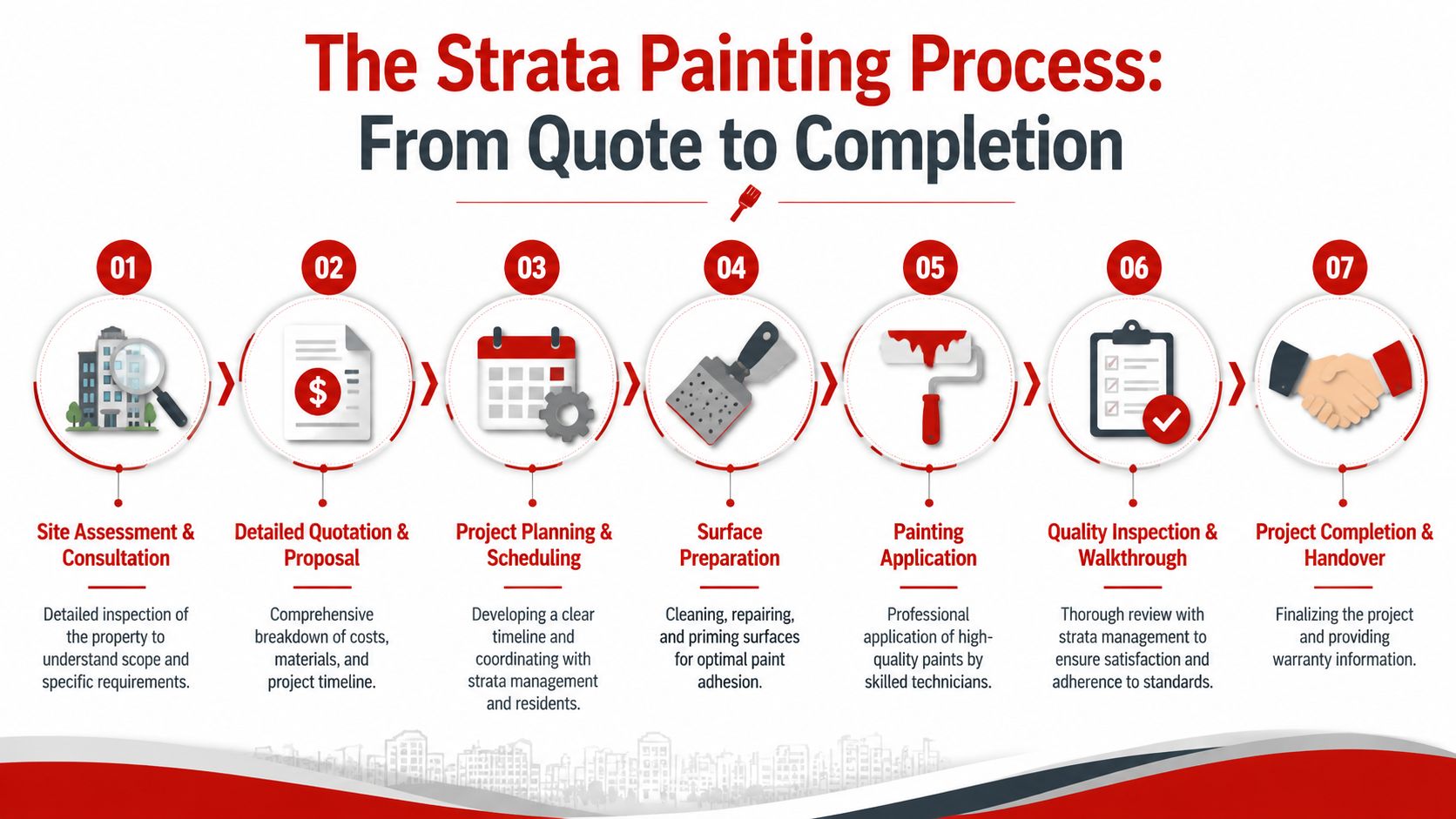
A proper strata painting project runs in stages, with the real work starting well before paint arrives on site. The sequence matters because once residents are notified and access is booked, delays become expensive and frustrating quickly.
What happens before the quote is accepted
The first site visit should be diagnostic, not just administrative. The contractor needs to inspect coating failure, water staining, blistering, chalking, timber movement, corroded metal, failed sealant lines, and access constraints. Without that, the quote is just a guess with a margin on top.
One Australian strata painting guide notes that more than 70% of strata buildings require remedial repair before repainting can begin, with common pre-paint works including concrete spalling repair, render patching, joint sealing, timber repair, crack repair, and localised waterproofing, which is why strata projects demand diagnosis and repair capability as much as painting labour (Dukes strata painting guide).
That finding lines up with what contractors see on older Melbourne stock. A committee may ask for a repaint. The site often needs a remedial programme first.
A good proposal should spell out substrate prep, nominated coatings, exclusions, access assumptions, staging, and defect treatment. If you want a sense of how detailed surface preparation should be before any coating system is applied, this guide on how to prepare walls for painting is a useful reference point.
Later in the process, residents often want a visual explanation of what happens and when. This short walkthrough helps set those expectations:
Preparation is where the project is won or lost
Preparation decides whether the new coating lasts. On strata buildings, that usually means wash-downs, mould treatment where needed, scraping, sanding, feathering failed edges, patching cracks, replacing decayed timber sections, sealing joints, and priming bare or unstable areas with the right system.
Different substrates need different treatment. Water-damaged plaster might need a stain-blocking primer. Dense or glossy surfaces may need an adhesion primer. Hairline movement in rendered walls may call for a more flexible system, while metal handrails need rust treatment and a primer suited to that substrate.
A typical preparation sequence looks like this:
- Inspect and mark defects on elevations and common interiors.
- Clean surfaces so primers and topcoats can bond properly.
- Repair substrate issues such as cracks, patch failures, minor timber damage, and failed sealant junctions.
- Spot-prime or full-prime where the existing coating or substrate requires it.
- Mask and protect glazing, paving, cars, landscaping, and entry points before application begins.
The committee sees colour. The contractor has to see failure points.
Application handover and defect close-out
Once preparation is complete, coating application becomes much more predictable. Most strata scopes call for undercoat or primer where required, followed by the specified finish coats. The important part isn't just the number of coats. It's whether the system is matched to the exposure, substrate condition, and future maintenance expectations.
On handover, the site shouldn't be considered “finished”. It should be inspected zone by zone with the strata manager or committee representative, with touch-ups, missed items, and protection removal checked systematically. Newline Painting, for example, works from a written quote through to supervisor sign-off and a final walkthrough, which is the right model for occupied buildings where communication matters as much as finish quality.
What doesn't work is rushing the last few days. That's when masking gets pulled too early, patchy touch-ups appear in side light, and residents notice every shortcut.
Navigating Legal Insurance and Compliance Requirements
On a strata project, compliance isn't paperwork for the file. It's part of the job itself. Multi-residential buildings bring more people, more access risk, more shared areas, and more exposure if something goes wrong.
Insurance and contractor due diligence
The committee should verify insurance before comparing finishes or colours. Australian strata guidance recommends that contractors on high-rise projects carry at least $30 million in public liability insurance and that owners corporations allow 4 to 8 weeks for resident notification and scheduling to reduce access conflicts and support safer planning (ShedBlog guidance on strata painting).
That benchmark matters because a strata site is rarely self-contained. You've got residents, visitors, delivery drivers, parked vehicles, shared walkways, and often retail or office traffic at ground level. If a contractor isn't set up for that environment, the owners corporation carries unnecessary risk.
Insurance checks should cover more than a certificate held on file months ago. Confirm the policy is current, that the insured entity matches the contracting entity, and that the scope of work aligns with the policy context. For committees reviewing basic due diligence, this summary of public liability insurance for painters is a practical starting point.
Site safety documentation and occupied-building controls
Safe Work Method Statements matter most when the job includes high-risk activities such as working at heights, aerial work platforms, scaffold interfaces, or difficult access around live pedestrian areas. The document itself doesn't make a job safe. What matters is whether the contractor can turn it into real controls on site.
Look for evidence of organised site management:
- Access control: Barricades, exclusion zones, signage, and clear pedestrian diversions.
- Daily housekeeping: No loose masking, open tins, or trip hazards left in shared areas.
- Trade sequencing: Repairs, cleaning, access equipment, and painting coordinated in the right order.
- Resident interface: A named contact for notices, balcony access, and complaints.
A committee should also ask who supervises the project day to day. A strata building isn't the place for a contractor who disappears after the quote is signed and leaves residents chasing answers from whoever happens to be holding a brush.
Compliance problems rarely start with the paint. They start with poor planning, unclear responsibility, and weak site control.
Budgeting for a Strata Repaint and Understanding Costs
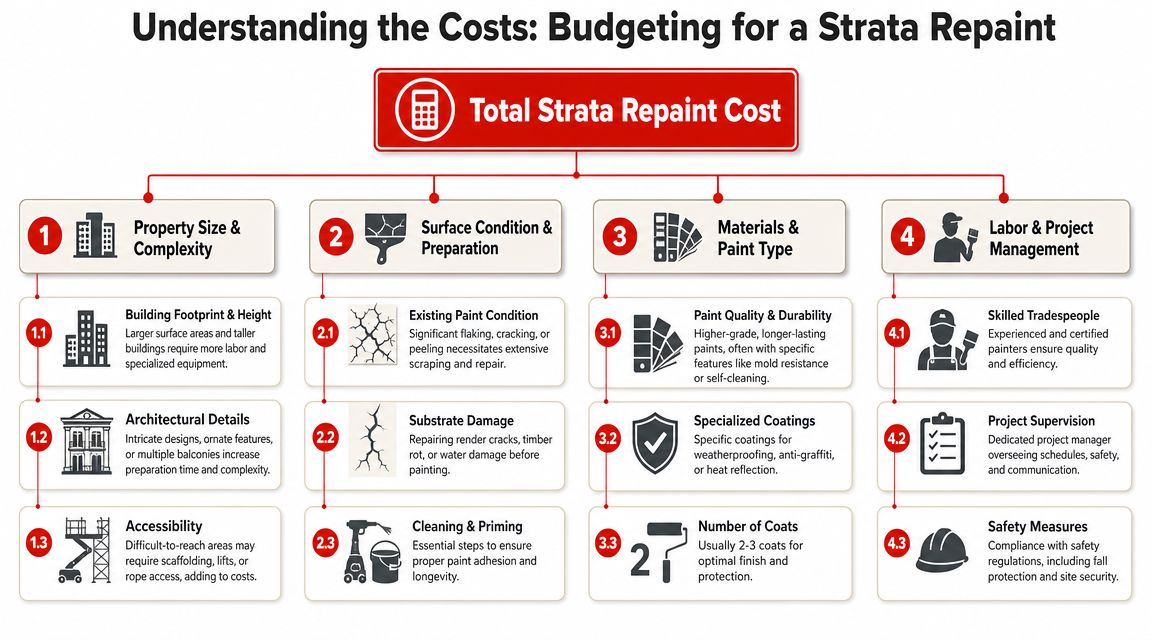
The cost of a strata repaint comes from scope complexity, substrate condition, access method, and project management load, not just paint quantities. If two quotes are far apart, the difference is usually hiding in preparation assumptions or access planning.
What drives the price up or down
Height changes everything. A low-rise block in Northcote with easy perimeter access is a different proposition from a taller building in South Yarra with tight boundaries, basement traffic, and balconies that need individual coordination.
Condition is the next cost driver. If the old coating is stable, the programme stays cleaner. If the building has peeling acrylics, brittle caulking, cracked render, rust bleed, or repeated moisture staining, labour rises quickly because every failing area has to be stabilised before topcoats go on.
The major cost categories usually look like this:
| Cost area | What it covers | Why it matters |
|---|---|---|
| Access | Scaffolding, lifts, edge protection, restricted-area setup | Difficult access increases labour and programme risk |
| Preparation | Cleaning, scraping, sanding, repairs, joint sealing, priming | Better prep gives the coating system a chance to last |
| Materials | Primers, undercoats, finish coats, specialty systems | Product choice affects durability and maintenance burden |
| Management | Supervision, resident notices, staging, defect tracking | Occupied buildings need tighter coordination |
The wider market also helps explain why quoting has become more formal. Independent market research reports the global house painting service market was valued at $93.6 billion in 2025 and is projected to reach $162.4 billion by 2034, implying a 6.3% CAGR, which reflects a large, increasingly professionalised sector where documented quoting and asset-preservation logic are becoming standard practice (Dataintelo house painting service market report).
How to compare quotes properly
A lower price can still be the more expensive decision if the quote is light on prep or vague on exclusions. Committees should compare method against method, not just bottom-line totals.
Check whether each quote identifies:
- Surface preparation clearly: Not just “prepare as needed”, but what that means in practice.
- Paint system by substrate: Masonry, timber, steel, ceilings, doors, and traffic areas should be separated where relevant.
- Access assumptions: What happens if parked cars, locked balconies, or scaffold changes affect the programme.
- Defect treatment limits: Which repairs are included, and how latent defects are handled.
- Handover standard: Whether the contractor allows for walkthroughs and close-out items.
If you're trying to sense-check a proposal before committee review, a tool like this painting cost calculator in Australia can help frame the variables, although an on-site inspection is still the only reliable basis for a strata scope.
What doesn't work is choosing a contractor on paint brand alone. Dulux, Haymes, Taubmans, Berger, and Wattyl all have systems that can perform well when matched correctly. The failure point is usually the prep standard or the wrong system for the exposure, not the label on the tin.
Managing Timelines and Minimising Disruption to Residents
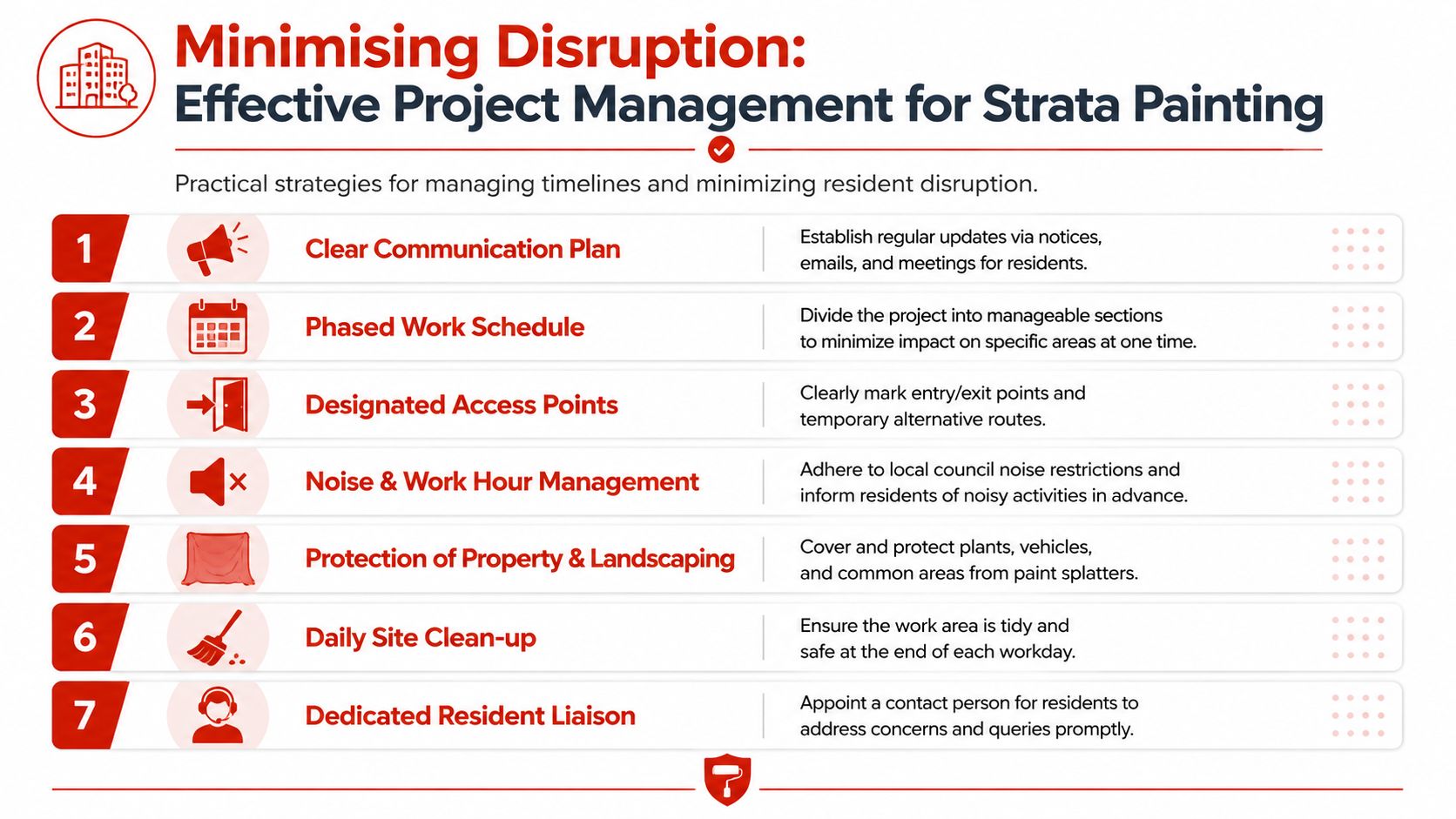
Resident disruption is controlled through sequencing, notice, and predictable site behaviour. Most complaints on strata repainting jobs come from uncertainty, not from the existence of the work itself.
Set the programme before the job starts
The contractor should divide the building into zones before mobilisation. That may be by elevation, level, stair core, corridor wing, or balcony line. Residents cope better when they know which area is live, which areas are next, and what access changes apply to each stage.
A practical programme usually includes:
- Notice periods: Written notice before each zone starts.
- Daily work hours: Clear start and finish times for noisy tasks.
- Balcony and window coordination: Instructions on clearing items and keeping openings closed during active works.
- Shared-area controls: Lift use, parking changes, and entry reroutes managed in advance.
On larger occupied jobs, the same planning mindset used to avoid moving day slowdowns is relevant. Small coordination failures, poor access timing, unclear loading zones, or last-minute resident conflicts can slow the whole programme.
Resident communication has to be structured
Committees should expect more than a single notice at the start. A live building needs regular updates, especially if weather, access, or hidden repairs change the sequence.
The communication chain should be simple:
- Pre-start notice with dates, affected areas, and resident actions required.
- Zone-specific reminders shortly before crews move into each section.
- Progress updates if staging changes.
- Issue escalation path so residents know who to contact.
A quiet site isn't always a well-managed site. A well-managed site is one where residents know what's happening before they need to ask.
Daily clean-up matters just as much. Corridors, entry paths, and car park interfaces should be left tidy and safe every day. Residents will forgive inconvenience. They won't forgive messy access ways, overspray risk near cars, or unanswered questions.
How to Choose a Qualified Strata Painting Contractor
Choose the contractor the way you'd choose a risk manager with brushes. The standard residential painter who does neat work on houses may still be the wrong fit for a building with committees, common property boundaries, access equipment, and resident liaison obligations.
Questions that expose weak operators quickly
Start with the questions that force specifics. Ask what defects they expect to see on your building type, how they document prep, who supervises daily works, and how they handle areas that can't be accessed on the planned date.
Then ask for evidence, not reassurance.
A solid shortlist should be able to show:
- Relevant building experience: Similar apartment blocks, mixed-use properties, or occupied common-area projects in Melbourne.
- Detailed methodology: Cleaning, repairs, primers, finish coats, staging, and defect close-out.
- Insurance position: Current documents and clear acknowledgement of the site's risk profile.
- Trade capability: Who is doing the work and who signs it off.
- Warranty terms: A workmanship warranty stated in writing.
One useful benchmark is accountability after completion. Newline Painting offers a 7-year workmanship warranty, carries $20M public liability insurance, and works from written scopes and supervisor sign-off, which are the kind of concrete checks committees should look for when comparing any contractor.
What a reliable contractor should put in writing
The quote should read like a project plan, not a sales note. If the document is vague, the site will be vague too.
Look for these items before approval:
- Defined scope boundaries between common property and exclusions.
- Preparation standard with defect categories identified.
- Specified paint systems by area and substrate.
- Programme assumptions including resident access and weather dependencies.
- Variation process for latent deterioration uncovered after setup.
- Handover procedure with inspection and touch-up allowance.
A contractor who avoids detail usually does it for one of two reasons. Either they haven't understood the building yet, or they want room to reinterpret the scope later. Neither helps the committee.
Long-Term Value with a Painting Maintenance Plan
The smarter way to treat strata painting is as planned maintenance, not a cosmetic event that gets revisited only when failure is obvious.
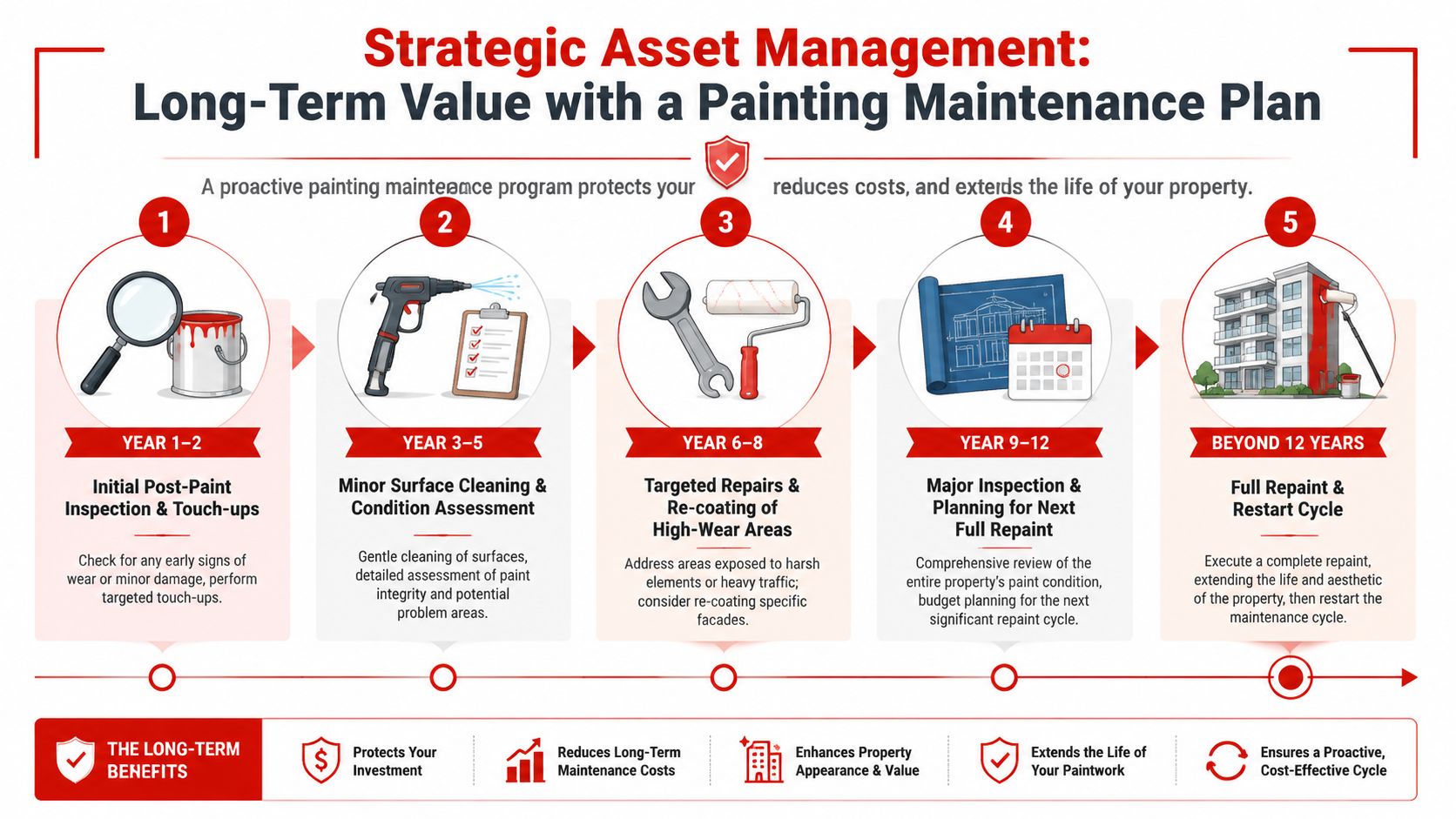
Industry specialists increasingly frame strata painting this way because regular maintenance is better suited to weather exposure and helps prevent water intrusion linked to delayed repainting (Avello guide to body corporate and strata painting). In Melbourne, that approach makes sense on everything from older brick walk-ups to newer apartment complexes where sun, moisture, and movement affect different elevations differently.
A maintenance plan doesn't have to mean full repaints at short intervals. It can mean scheduled inspections, wash-downs, localised repairs, sealant reviews, and touch-ups in high-wear areas before they become broad failures. For internal upkeep between major works, this Neat Hive Cleaning's guide for homeowners is also useful for understanding how painted surfaces can be cleaned without causing avoidable wear.
The long-term value is simple. Planned upkeep usually gives the committee more control over timing, fewer defect surprises, and a cleaner budget path than waiting until the building looks visibly tired.
If your owners corporation is planning a repaint, the next step is an on-site inspection and a scope that matches the building you have, not the one everyone hopes it is. Newline Painting provides free on-site quotes across Melbourne. If you want a clear written proposal covering preparation, paint systems, staging, and site logistics, call 1300 044 206.