
You're probably at the point where paint no longer feels like the right answer.
The wall might be in a renovated Victorian in Kew, a sharp apartment in South Yarra, or a reception area that needs more depth than a flat acrylic can give. You want something with character, but you also want straight answers about maintenance, wet areas, repairability, and cost.
That's where Venetian plaster earns its place. In Melbourne, it isn't just a decorative trend. It suits older housing stock, heritage-sensitive refurbishments, and high-end interiors where the finish needs to look deliberate, not generic. The catch is that it only performs well when the substrate, build-up, and sealing are handled properly.
Table of Contents
- What Is Venetian Plaster and Why Is It Valued
- The Pros and Cons for Melbourne Homes
- Venetian Plaster Costs in Melbourne
- The Application Process from Prep to Polish
- Comparing Finishes Venetian Plaster vs Limewash vs Feature Paint
- Is Venetian Plaster Right for Your Project Case Studies
- Choosing a Qualified Melbourne Artisan
What Is Venetian Plaster and Why Is It Valued
Venetian plaster is a handcrafted mineral wall finish, not just a tin of decorative coating. Its value comes from the material itself and from the way it's applied, with multiple thin trowelled layers building depth that standard paint can't reproduce.
It's commonly associated with a polished stone or marble effect, but the distinction goes deeper than that. A good finish has movement, compression, and light reflection across the surface. It shouldn't look printed on or mechanically uniform.
Industry descriptions used in Melbourne note that Venetian plaster is made from natural materials such as lime and marble dust, and that matters in older properties where a breathable, period-appropriate wall system is often preferred over standard acrylic coatings. That's one reason it remains relevant in heritage-sensitive work across suburbs with strong Victorian and Federation housing stock, including places like Kew and Camberwell, as noted by Melbourne Venetian Plaster's overview of lime and marble dust finishes.

Why it looks different from paint
Paint sits on a wall as a film. Venetian plaster is built by hand in thin passes, then compressed and polished to change the way light moves over the surface.
That gives you a few visual qualities paint usually doesn't deliver:
- Depth rather than flat colour. The finish has internal variation, especially when viewed from different angles.
- Soft movement. Good plaster has controlled tonal shifts instead of roller stipple or brush marks.
- A stone-like feel. Even when smooth, it reads as a mineral surface rather than a coated plasterboard sheet.
Practical rule: If you want perfectly uniform colour and texture across every square metre, a premium paint system is usually the better fit. Venetian plaster is valued because it has variation, not despite it.
Why Melbourne clients ask for it
In Melbourne, the finish works in two very different settings.
The first is heritage refurbishment, where clients want a wall surface that sits more comfortably beside older cornices, architraves, fireplaces, and solid masonry. The second is contemporary interior design, where a continuous mineral wall can replace a standard feature paint and give a room more architectural weight.
That range is why Venetian plaster keeps showing up in inner-suburban renovations. In a Hawthorn terrace, it can feel consistent with the age of the building. In a newer Armadale or Toorak interior, it can sharpen the room without adding visual clutter.
The Pros and Cons for Melbourne Homes
Venetian plaster suits Melbourne homes when the room, substrate, and maintenance expectations all line up. It does not suit every wall, and the wrong application in the wrong room can become an expensive lesson.
The strongest advantage is that it delivers a continuous, high-character finish without relying on wallpaper joins or conventional paint texture. In older solid-wall homes, many owners also value the fact that mineral finishes are often chosen where a more breathable wall build-up is preferred. In cleaner-lined apartments, the appeal is usually visual. Less trim, fewer breaks, more surface depth.
Where it performs well
Some rooms naturally suit Venetian plaster better than others.
- Entry halls and living areas tend to be the safest choice because the wall can be seen in changing light and usually avoids hard daily wear.
- Feature walls in bedrooms or dining spaces work well when the aim is atmosphere rather than a flat painted statement.
- Commercial reception areas and client-facing interiors often benefit from the material look, especially when the design brief is more architectural than decorative.
It's also a strong option where clients want to avoid the look of acrylic paint entirely. A polished or softly burnished wall in Richmond or Albert Park can sit far better with timber floors, period details, and custom joinery than a standard low-sheen system.
The trade-offs clients should know
The downsides are real.
First, Venetian plaster is a specialist finish. The labour is slower, the prep standard is higher, and touch-ups aren't as simple as opening a leftover paint tin. If a wall is chipped by furniture, repaired after electrical work, or stained in one isolated spot, patching needs judgement. On some finishes, a local repair can still show.
Second, suitability in kitchens, bathrooms, and laundries depends far more on execution than on marketing. Melbourne homeowners often get broad claims about luxury and durability, but the better question is whether the wall has been prepared, sealed, and located appropriately. Practical guidance from a Melbourne plastering source points out that durability in moisture-prone rooms depends heavily on correct sealing and substrate preparation, and that cleaning, repair, and long-term upkeep are often the overlooked part of the conversation, as discussed by Sublime Venetian Plastering's maintenance notes.
Wet-area performance is never just about the finish itself. It's about the wall behind it, the sealer over it, and how much direct moisture the surface will actually cop.
A quick suitability check
| Situation | Usually a good fit | Usually a poor fit |
|---|---|---|
| Formal living room feature wall | Yes | |
| Heritage entrance hall | Yes | |
| Powder room with controlled moisture | Often | |
| Main shower enclosure | Often | |
| Rental hallway with frequent knocks and patching | Often | |
| Apartment living area feature wall | Yes |
If you want a finish that hides frequent impact damage, allows easy spot repairs, and behaves like standard paint during tenancy turnover, Venetian plaster usually isn't the easiest system to own.
Venetian Plaster Costs in Melbourne
Venetian plaster in Melbourne is a premium finish, and the quote should be read as a build-up of labour, preparation, material choice, and finish complexity, not as a simple per-metre paint rate.
A lot of clients ask for a square metre figure first, which is understandable, but it only tells part of the story. Two walls of the same size can price very differently if one is flat, sound, and ready to go, while the other has old cracking, poor previous patching, or difficult access around joinery and lighting.
What usually drives the quote
The biggest cost variables are practical ones:
- Substrate condition. If the wall needs stabilising, skim repair, sanding, or specific priming, labour moves quickly.
- Finish level. A softer matte mineral look and a polished, high-sheen finish don't demand the same amount of trowel work.
- Wall shape and access. Curves, bulkheads, stair voids, nib walls, and tight return corners take longer than open flat areas.
- Protection and staging. Occupied homes in places like Malvern or Brighton often need more masking, sequencing, and furniture management than empty renovation sites.
- Sample work. Most careful jobs need sampling before full application, especially when colour and sheen need to be signed off in the actual room light.
If a quote for Venetian plaster looks close to a standard repaint, something has probably been left out.
What a proper written quote should spell out
You want scope, not just price.
A useful quote should tell you what prep is included, what parts of the room are excluded, how corners and existing defects will be handled, and what protection and sealing are allowed for. It should also make clear whether the price assumes an ideal substrate or whether wall repair has already been priced in.
Here's the sort of checklist worth asking for:
- Surface condition assessment. Are cracks, drummy areas, or failed previous coatings included in the scope?
- Primer and base preparation. What system will the plaster go over?
- Number of application stages. How many passes are allowed for?
- Sealer or protective finish. Is it included, and where is it suitable?
- Repair expectations after handover. Can local patching be blended, or would full-wall work be more realistic?
Cost transparency matters more than a cheap headline number
For owners and property managers, the expensive mistakes usually come from assumptions. One party assumes wall prep is included. The other assumes it's not. Then the site starts, defects appear, and the variation discussion begins.
At Newline Painting, the useful part of a quote isn't the PDF itself. It's the detail behind it. A written scope that identifies prep standards, system choice, and finish expectations is what keeps a specialty finish accountable.
If you're comparing proposals, compare the preparation standard and finish schedule, not just the bottom line.
The Application Process from Prep to Polish
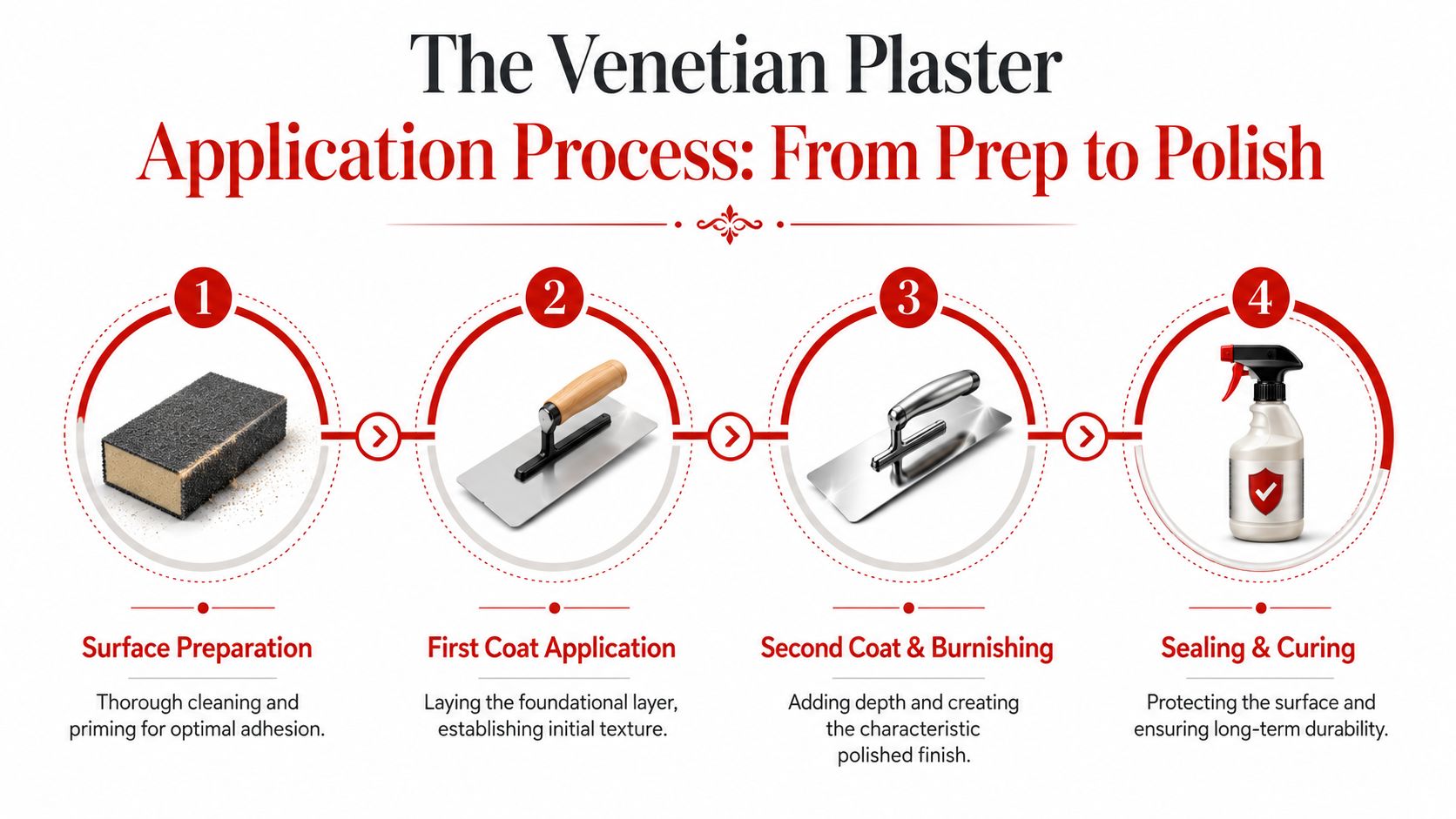
Venetian plaster succeeds or fails before the first decorative pass goes on. The final sheen and depth come later, but the substrate decides whether the finish will sit flat, bond properly, and age well.
A professional sequence is methodical rather than dramatic. There's no shortcut stage that replaces prep.
Prep decides the finish
The first step is always substrate assessment. Existing paint condition, plaster integrity, old patching, moisture history, and surface flatness all matter. If the wall has movement cracks, swelling, contamination, or poorly feathered repair work, Venetian plaster will highlight it rather than hide it.
That's why standard paint prep habits often aren't enough. The wall needs to be clean, stable, and consistently keyed. If you're comparing systems, the prep principles are close to those used in careful repainting, and our guide to how to prepare walls for painting gives a useful baseline for what thorough wall prep should involve before any premium finish goes on.
Thin coats create depth
Technique is paramount. Venetian plaster is generally specified as a thin, multi-coat system, not a heavy one-coat build. One technical sheet specifies three coats, with the finish coat applied so thinly that it is not much thicker than a credit card, and lists finish-coat coverage at 485–540 sq. ft. per 5-gallon pail. The same source explains why over-applying material reduces the final mirror effect and makes the surface harder to trowel flat, as outlined in Master of Plaster's technical sheet.
In practical terms, the sequence usually looks like this:
- Base preparation coat to establish adhesion and a controlled starting surface.
- Body coat to begin texture, movement, and colour density.
- Finish coat applied very thinly, then compressed and burnished for depth and reflectivity.
The pressure of the trowel matters. The timing matters. So does the decision about when to leave the surface alone. Overworking the wall can flatten the character or create unwanted dark marks and ridging.
To see the process in motion, this short video gives a useful visual reference for the handwork involved.
A polished finish isn't created by piling material on. It comes from restraint, compression, and keeping each layer controlled.
Sealing is not optional
The final stage depends on where the plaster is being used and how exposed the wall will be. In low-contact feature areas, the sealer choice may be mostly about protection and cleanability. In kitchens, bathrooms, or busy circulation spaces, sealing becomes part of the performance system.
A few site realities matter here:
- Bathrooms and laundries need a conservative approach. Decorative plaster may suit some walls, but exposure zones should be chosen carefully.
- Kitchen splash areas need more caution than kitchen feature walls well away from direct mess.
- Rental or commercial settings usually need a finish that can tolerate cleaning protocols and occasional damage.
Good application is quiet work. There's a lot of waiting, checking, and correcting before the room gets to the polished result clients notice.
Comparing Finishes Venetian Plaster vs Limewash vs Feature Paint
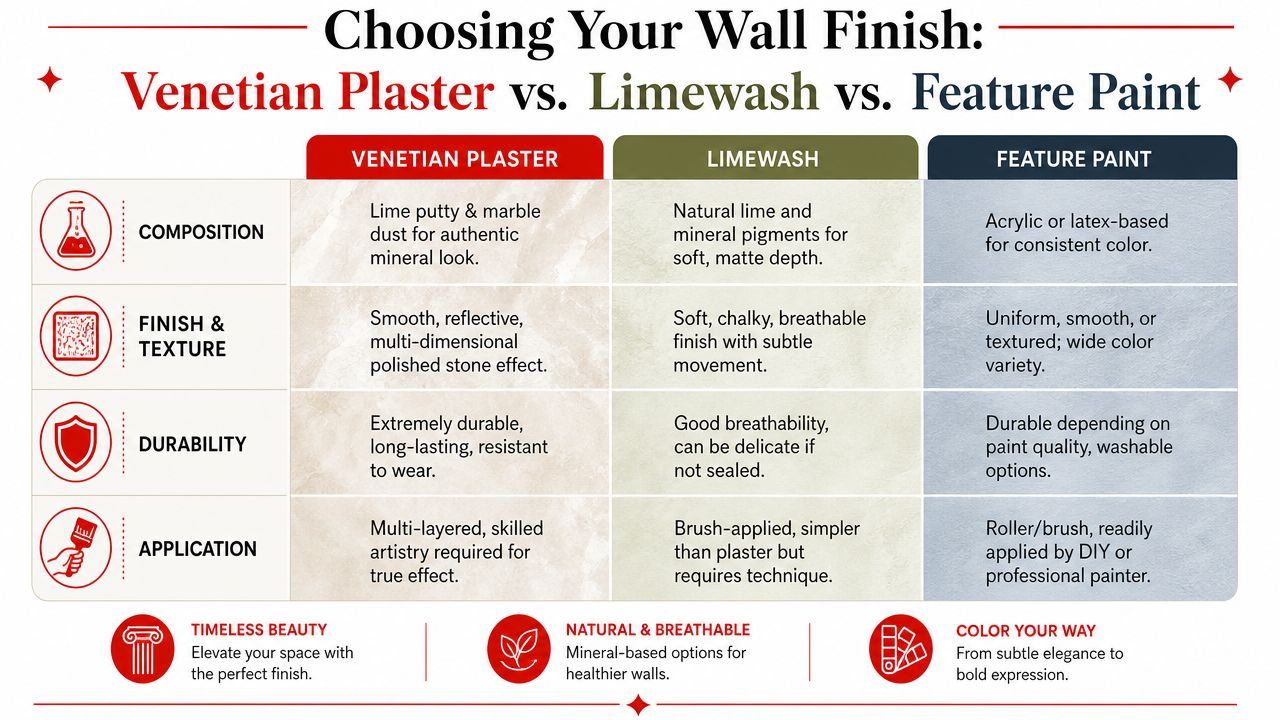
Most clients aren't really choosing between products. They're choosing between looks, upkeep, and budget tolerance. Venetian plaster, limewash, and feature paint can all work in a Melbourne interior, but they solve different problems.
The fastest way to decide is to compare what each finish is like to live with once the room is furnished and occupied.
How the finishes differ in practice
| Criteria | Venetian plaster | Limewash | Feature paint |
|---|---|---|---|
| Visual effect | Polished or softly burnished mineral depth | Cloudy, chalky movement | Uniform colour or controlled texture |
| Surface character | Seamless, hand-trowelled | Soft and matte | Depends on product and application |
| Repairability | Can be complex on visible walls | Usually easier than polished plaster, but still technique-sensitive | Usually simplest |
| Best fit | High-end feature walls, heritage-sensitive interiors, architectural spaces | Period homes, textured relaxed interiors, breathable decorative work | General living spaces, rentals, broad repaint programs |
| Budget position | Highest | Mid-range to premium | Broadest range |
Venetian plaster is the strongest choice when you want a wall to read as a material, not just a colour. It suits formal rooms, foyers, and feature walls where lighting can reveal the movement in the finish.
Limewash is a different mood entirely. It's softer, more diffuse, and less polished. In many Melbourne homes, especially older terraces and Federation rooms, it gives enough mineral character without the tighter reflectivity of Venetian plaster. If that's the direction you're considering, our page on limewash painting in Melbourne shows where that finish tends to make more sense.
Feature paint remains the practical workhorse. If you need consistency across multiple rooms, easier touch-ups, or a cleaner solution for property management and turnover, it's often the right answer.
Best fit test: Choose Venetian plaster when the wall itself is meant to be part of the architecture. Choose limewash when you want softness and movement. Choose feature paint when maintenance simplicity matters most.
Which one works best in different property types
A renovated Hawthorn or Camberwell period home often suits lime-based decorative finishes because they sit more naturally beside original details. A sharper apartment in South Yarra might suit either a polished plaster feature wall or a very controlled premium paint, depending on whether the client wants texture or visual restraint.
For investors and agents, feature paint often wins because it's easier to standardise. For owner-occupiers creating a statement room, Venetian plaster usually justifies itself better.
Is Venetian Plaster Right for Your Project Case Studies
Venetian plaster is right for a project when the brief calls for surface character, not just colour. In Melbourne, demand is supported by a mature local ecosystem of suppliers, specialist services, and training, which suggests the finish has moved beyond a rare craft and into a recognised decorative system for premium interiors and feature walls, as noted by Venetian Plaster Shop Australia's specialist supply and training overview.
That matters because it changes the conversation. Clients aren't asking whether the finish exists locally. They're asking whether it suits their wall, their building, and the way they use the room.

Three Melbourne project types where it works well
A contemporary living room feature wall in Toorak
The client wants a focal wall that feels architectural rather than decorative. Standard paint looks too flat once the daylight hits it. A darker Venetian plaster finish works well here because the room already has clean joinery, controlled lighting, and enough open wall area for the movement in the finish to read properly.
A Federation entrance hall in Malvern
This is a different brief. The client isn't chasing gloss for the sake of gloss. They want a wall finish that feels more at home with original timber details, high ceilings, and old plaster proportions. A lighter, softly polished plaster can add depth without making the hallway feel over-designed.
A CBD reception wall in a client-facing commercial space
Commercial use can suit Venetian plaster if the wall is in the right place. Reception backdrops, meeting room feature walls, and statement arrival zones are usually safer than high-impact corridor corners. The finish gives the space more permanence than a typical painted feature wall, provided the maintenance expectations are realistic.
A common thread runs through all three. The finish works best where the wall can be seen, appreciated, and protected from constant abuse. It's less convincing on random small sections where it has to fight with too many doors, vents, artworks, and interruptions.
Choosing a Qualified Melbourne Artisan
Venetian plaster is specialist work. A painter who can cut a clean line and deliver a strong acrylic repaint won't automatically have the hand skills or judgement for a polished mineral finish.
The first thing to check is the portfolio. You want to see local walls, close-up finish detail, and examples in rooms similar to yours. Wide-angle photos alone won't tell you much. Ask how the contractor handles substrate correction, sample approval, and repairs if another trade damages the surface after completion.
What to ask before you accept a quote
Use a short, direct checklist:
- Ask about substrate prep. The answer should be specific, not vague.
- Ask how repairs are handled later. Some finishes patch better than others.
- Ask what protection is included. Especially in occupied homes.
- Ask for insurance details. Specialty finishes still need ordinary commercial accountability.
- Ask what workmanship cover applies. If someone won't stand behind the prep and application, that's useful information.
For credibility checks, reviews help, but only when you read them properly. This short article on Constructo Marketing's guide to Google reviews is useful because it explains why review quality and consistency matter more than a raw star badge.
If you're vetting Newline Painting as one option, the practical proof points are straightforward: the company is Melbourne-based, works across the metro area, uses a written quoting process, carries $20M public liability insurance, and backs workmanship with a 7-year warranty. If insurance verification matters for your project, the details sit on our page about public liability insurance for painters.
A good artisan won't oversell Venetian plaster. They'll tell you where it works, where it doesn't, and whether a different finish would suit the room better.
If you're considering Newline Painting for a Venetian plaster or specialty wall finish in Melbourne, request a free on-site quote and we'll assess the substrate, room suitability, finish options, and scope in plain terms. You can also call 1300 044 206 to discuss the project before booking a site visit.