
Most advice about a painting cost calculator in Australia starts with the same idea: enter your room size, pick interior or exterior, and you'll get a useful budget. That's only partly true. A calculator can give you a starting range, but it can't properly price a Melbourne repaint unless it understands what is being painted, how much prep is hiding under the existing finish, and how difficult the site is to work on.
That gap matters most on real Melbourne housing stock. A contemporary apartment in South Yarra behaves very differently to a weatherboard in Northcote or a Federation home in Camberwell with ornate cornices, aged architraves and multiple previous paint layers. The square metres might look similar on paper. The labour and paint system usually aren't.
Table of Contents
- Why Online Painting Calculators Fall Short
- How Painting Cost Calculators Actually Work
- The True Cost Drivers Behind a Professional Painting Quote
- Typical Painting Price Ranges in Melbourne 2026
- Example Painting Cost Calculations in Practice
- How to Prepare for an Accurate Painting Quote
- Turning Your Estimate into a Formal Quote
Why Online Painting Calculators Fall Short
Online calculators fall short because they treat painting like a clean formula when most repaint work is a condition problem first and a coverage problem second.
They're useful for rough budgeting. They're weak at scope. A homeowner can enter the size of a living room, but the calculator still doesn't know whether the walls are sound, whether there's water staining on the ceiling, whether the previous colour is deep enough to affect hiding, or whether the timber trim needs oil-based enamel rather than a simple acrylic wall system.
That issue gets sharper in Melbourne. Older homes in Kew, Hawthorn and Albert Park often carry detailed timberwork, cracked plaster, or patched areas that need a stain-blocking primer before any topcoat goes on. Bayside exteriors in places like Brighton and St Kilda often face more salt and weather exposure than a sheltered suburban façade. A generic online tool can't see any of that.
Practical rule: If a calculator gives the same estimate for a clean apartment repaint and a peeling weatherboard exterior of similar size, it isn't pricing the job. It's pricing a simplified version of the job.
A proper quote starts with surfaces, condition, access and finish level. That's why fixed-price quoting in the field still matters. The estimator needs to inspect ceilings, trims, patching, moisture marks, access points, elevation changes, protection requirements and the paint system needed for each substrate.
For Melbourne property owners, the useful way to view a painting cost calculator Australia tool is this:
- Use it for first-pass budgeting. It helps you decide whether the project sits in a smaller refresh range or a full repaint range.
- Don't use it to compare contractors blindly. Two prices may look far apart because one includes thorough prep and the other doesn't.
- Expect site-specific variation. Heritage detailing, weathering, occupied homes and access constraints all change the labour profile.
That's also why a written site quote is more valuable than a quick online number. It can define what's included, what isn't, and what condition-related risks may change the final scope once work begins.
How Painting Cost Calculators Actually Work
Most painting calculators work by turning area into labour and materials, then applying a broad rate. That's the core logic. The detail sits in what kind of area they measure and what assumptions they make about coats, prep and trim.
Most calculators start with area and a default paint system
A practical benchmark from an Australian painting-cost calculator is that interior work is commonly priced at about AUD 60–100 per square metre, including one primer coat plus two finish coats, and another estimator uses a default paint coverage of 15 m² per litre, which means a 100 m² paintable surface requires about 6.7 litres per coat before allowing for a second coat and normal loss, according to the Hipages painting cost calculator benchmarks.
That tells you how these tools think. They assume a baseline system, a baseline coverage rate and a baseline level of prep. Once those assumptions are off, the estimate starts drifting.
Here's the usual calculator workflow:
-
Measure the area
The user enters room dimensions, wall area, ceiling area, or a house size. -
Apply a default rate
The tool multiplies that area by an interior or exterior rate. -
Estimate paint volume
It uses a coverage assumption to convert surface area into litres. -
Bundle labour and materials
The output becomes a single project estimate or a broad range.
That framework is fine for first-pass planning. It breaks down on detailed scope.
Paintable area is not the same as floor area
The biggest misunderstanding is the difference between gross floor area and paintable area.
Floor area tells you how big the home is. It doesn't tell you how much wall, ceiling, door and trim surface will be painted. A home with standard-height walls and minimal trim is one thing. A period home with high ceilings, decorative cornices, picture rails, panel doors and full architraves is another.
A painter prices surfaces and tasks, not just rooms.
That's why two homes with a similar floor plan can price very differently. The one with detailed trim, heavy patching and multiple substrates often needs more cutting in, more masking, more sanding and more product changes.
Common calculator blind spots include:
- Trim-heavy interiors where doors, skirtings, architraves and cornices take substantial labour.
- Colour changes from dark to light, or strong feature colours that affect hiding.
- Special primers such as stain-blocking systems for water marks or nicotine staining.
- Surface defects including flaking paint, hairline cracking, patch repairs and failed caulk lines.
- Occupied-home protection where furniture, flooring and joinery need careful masking and sequencing.
A calculator also tends to flatten finish quality into one average rate. In practice, there's a difference between a rental refresh and a high-detail repaint in a lived-in family home where clients want cleaner lines, smoother sanding and stronger defect reduction under low-sheen wall paint.
The result is simple. Online tools get the maths roughly right. They often get the scope wrong.
The True Cost Drivers Behind a Professional Painting Quote
A professional quote is driven by labour, preparation, materials, and business overheads. If one of those is under-allowed, the price may look attractive at the start and become a problem on site.

Labour sets the shape of the quote
Labour usually drives the structure of the estimate because painting is time-heavy work. Australian market data shows hourly painter rates are often around AUD 70–110, and site difficulty pushes labour up because harder access increases prep time and working time disproportionately, as outlined in this Australian house painter cost guide.
That's obvious on a Melbourne exterior. A straightforward single-storey façade with clear access is one thing. A multi-level house with narrow side paths, steep sections, fragile landscaping and weathered upper-storey timber is another. The second job often needs more setup, slower movement, more protection and more time on ladders or access equipment.
For property owners who manage several moving parts in a project, the same budgeting principle shows up outside painting too. For example, if you're also sorting out a website for a development, agency or property business, understanding Australian domain costs is useful for the same reason: small line items can look simple online until the actual scope and ongoing requirements are clear.
Preparation changes everything
Prep is where online calculators are weakest. It's also where cheap quotes often cut corners.
On a repaint, the painter may need to wash down, scrape loose coating, sand edges, fill damaged plaster, patch dents, gap skirtings, prime bare spots, seal stains, mask vulnerable finishes and protect the site before topcoats begin. None of that is visible in a one-line online estimate.
A few Melbourne examples make the point:
- Victorian and Federation interiors often carry ornate trims and older substrates that need slower, cleaner prep.
- Weatherboards can have open grain, failed fillers, movement at joints and areas of soft timber that need repair before coating.
- Bayside exteriors may show more surface wear from exposure, which changes washing, sanding and priming requirements.
If the existing surface is unstable, more topcoats won't fix it. The substrate has to be made sound first.
Paint system and access decide the finish and the risk
Material cost isn't just “paint”. It's the full coating system. That includes primers, undercoats, fillers, caulk, tape, masking film, abrasives and the right finish coat for the substrate and sheen level.
The choice of system affects both appearance and longevity. Acrylic low-sheen for living areas behaves differently to enamel on trim. An exterior weatherboard repaint may need a different approach to a masonry façade. Bathrooms and laundries can call for more moisture-aware specification than a dry bedroom.
Access has its own pricing logic. High walls, stairwells, narrow passages, steep blocks and busy occupied homes all slow down production and increase protection requirements. That's why a formal quote should identify access assumptions clearly, rather than burying them in a square-metre average.
This is also where a professional contractor's overheads belong in the number. Insurance, supervision, site protection, scheduling, warranty administration and quality control are part of the actual delivered cost. They aren't extras if the job is being run properly.
Typical Painting Price Ranges in Melbourne 2026
For budgeting, Melbourne owners can use broad market ranges, but they should treat them as planning numbers, not approval numbers. The local variation between apartments, period homes and weathered exteriors is too wide for a single flat rate to stay accurate.
Budget ranges for planning, not approval
Australian pricing guides report that standard interior painting typically falls around A$20–A$30 per square metre, detailed work with trim can rise to A$60–A$100 per square metre, exterior repainting can range from about A$15–A$60 per square metre, and whole-home projects can span from roughly A$4,000 for a small apartment to A$20,000+ for a large house, according to LocalAgentFinder's Australia-wide house painting cost overview.
Those ranges line up with what Melbourne owners usually see when comparing basic repaints against heritage or access-heavy work. A modern apartment in Richmond or South Yarra generally sits closer to the simpler end of the spectrum if the walls are sound and trim is limited. A detailed Edwardian or Federation home in Kew, Hawthorn or Camberwell usually won't.
| Project Type | Typical Price Range (AUD) |
|---|---|
| Standard interior repainting | A$20–A$30 per square metre |
| Detailed interior work with doors, architraves and trim | A$60–A$100 per square metre |
| Exterior repainting | A$15–A$60 per square metre |
| Whole-home project, small apartment to large house | A$4,000 to A$20,000+ |
Use those figures to build a budget envelope, not to approve a contractor. The quote still needs to answer basic questions that the table can't:
- What surfaces are included
- How much prep is allowed
- What coating system is specified
- Whether access equipment is included
- How occupied-site protection is handled
If you want a more detailed breakdown of residential pricing logic, this house painting price guide for Australia is a useful next step because it frames costs around actual project scope rather than a single generic rate.
Example Painting Cost Calculations in Practice
The best way to read a painting estimate is to follow the thinking behind it. The numbers matter, but the scope matters more.
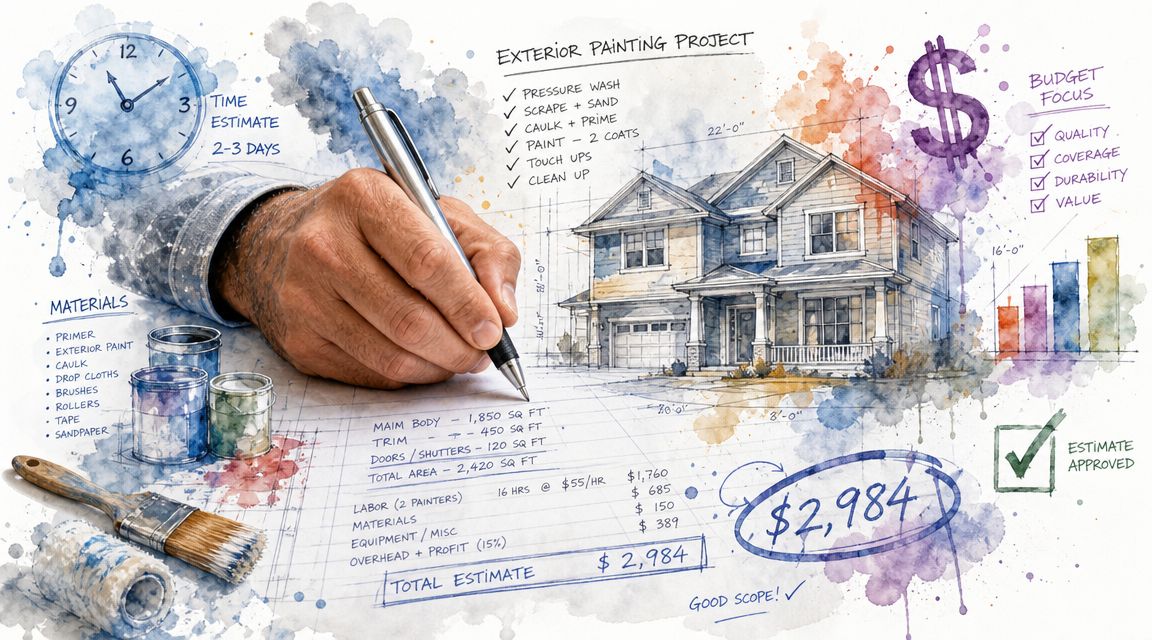
Example one South Yarra apartment bedroom
A bedroom repaint in a South Yarra apartment often looks simple on a calculator. Four walls, one ceiling, one door. Done.
In practice, the estimator checks whether the walls are marked or damaged, whether the existing colour is strong, whether there are settlement cracks above the cornice line, and whether furniture remains in the room. If the previous tenant left nail holes and patchy touch-ups, the prep standard becomes the deciding factor. A low-sheen acrylic may hide minor surface variation better than a flatter-looking finish under side light, but only if sanding and spot-priming are done properly.
The cost profile here is usually shaped by:
- Patch and repair load rather than raw room size
- Protection needs if the apartment is occupied
- Cutting-in detail around robes, windows and trims
- Colour change difficulty if covering a deep feature wall
A calculator gives a budget line. The site visit decides whether the job is a clean refresh or a defect-correction repaint.
Example two Northcote weatherboard exterior
A peeling weatherboard cottage in Northcote is where generic online estimates usually fail.
The painter first needs to determine whether the issue is simple chalking and localised failure, or broader coating breakdown. Loose paint may need scraping back, feather sanding and full spot priming. Open joints may need re-caulking. Damaged sections of timber may need repair before any exterior topcoat is worth applying. If elevations are exposed and weathered, the labour goes up fast because preparation becomes the project.
The estimating thought process sounds more like this:
- Is the timber sound enough to repaint
- How much loose or failed coating has to be removed
- What primer is needed on bare and weathered areas
- How difficult is access around fences, paths and garden beds
- Can the work be staged around Melbourne weather windows
Exterior quotes rise quickly when the surface is deteriorated, because every hour spent restoring a stable substrate is labour the calculator usually doesn't see.
On this kind of project, the cheapest quote is often the one that has allowed the least for prep. That may not become obvious until the painters are already on site.
Example three Camberwell heritage trims
A heritage-style interior in Camberwell can carry more labour in the trims than the walls.
Architraves, skirtings, picture rails, panel doors and decorative cornices all slow production. Each profile needs detailed sanding, filling, caulking and clean cutting-in. If the existing enamel has old brush ridges or local cracking, the preparation standard becomes visible in the final result. Gloss and semi-gloss finishes tend to reveal substrate defects more readily than lower-sheen wall paints, so the margin for poor prep is smaller.
On a quote like this, the estimator is usually weighing three competing priorities:
-
Finish level
A sharper heritage finish takes more time in sanding and detail work. -
Paint system compatibility
Trim systems often differ from wall systems, especially if enamel surfaces are involved. -
Client expectations while occupied
Detailed interior work in a lived-in home needs careful sequencing, protection and communication.
This is also where written scope matters. “Paint living areas” is not precise enough if trims, panel doors and ceilings all sit in different condition categories.
How to Prepare for an Accurate Painting Quote
If you want an accurate quote, prepare the scope before the painter arrives. You don't need trade knowledge. You do need clarity.
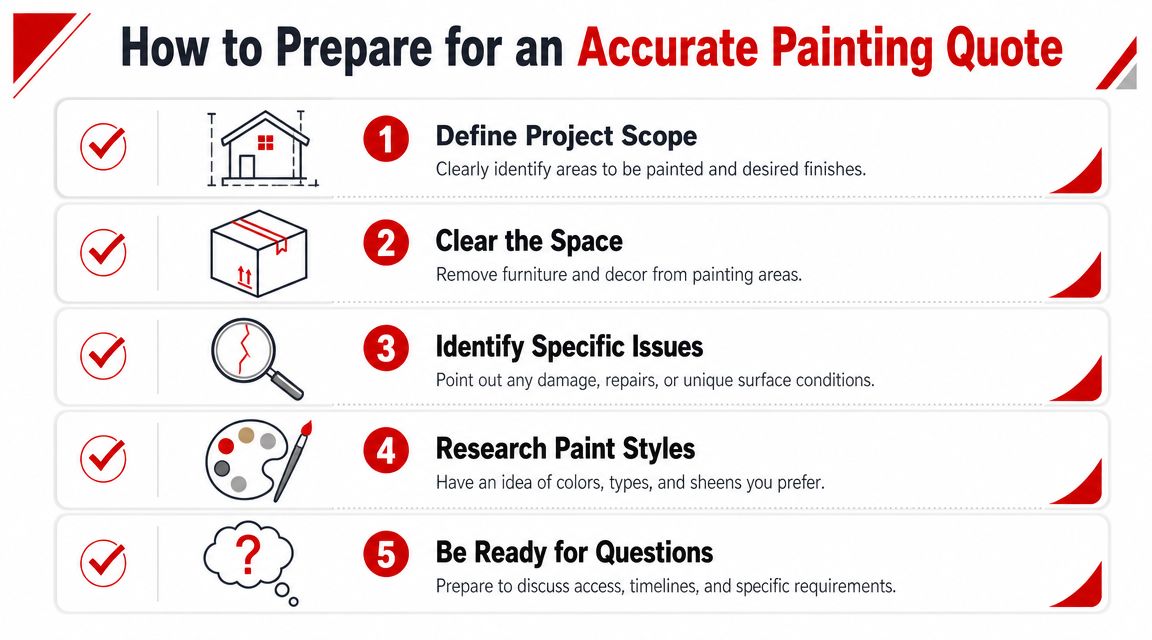
What to have ready before the site visit
Start with a simple list of spaces and surfaces. Note whether you want walls only, or ceilings, doors, frames, skirtings, external timber, fencing or specialty finishes included. If there are damaged areas, photograph them in good light and point them out during inspection.
A short checklist helps:
- Define the scope clearly. Separate walls, ceilings, trims, doors and exteriors so nothing is assumed.
- Record visible defects. Cracks, stains, peeling areas, mould marks and swollen timber should be identified early.
- Decide on occupancy conditions. Let the estimator know whether the home is vacant, occupied, furnished, tenanted or part of a pre-sale schedule.
- Have colour direction ready. Even if colours aren't final, say whether you're staying similar or making a major change.
- Raise access constraints. Narrow side paths, apartment lifts, parking limits and stair-only access all affect labour.
For owners who like software-led budgeting, tools such as Exayard painting estimating software can help organise scope and estimating logic. They're still only as good as the condition and access information entered.
If your project is mainly internal walls, it also helps to review what's normally included in a straightforward interior wall painting service in Melbourne before comparing quotes.
A short visual guide can help you organise the right questions before inspection:
How to compare quotes properly
Don't compare quotes by bottom-line price alone. Compare scope against scope.
Check whether each quote states the prep standard, the number of coats, the paint brands or systems, what protection is included, and whether access equipment or repair work sits inside the fixed price or outside it. If one quote says “full repaint” and another itemises wash, scrape, sand, fill, prime and topcoats, the second quote is usually easier to trust because it's easier to verify.
A useful quote doesn't just tell you what the job costs. It tells you what the crew will actually do.
That's the point where an estimate turns from a budget tool into a project document.
Turning Your Estimate into a Formal Quote
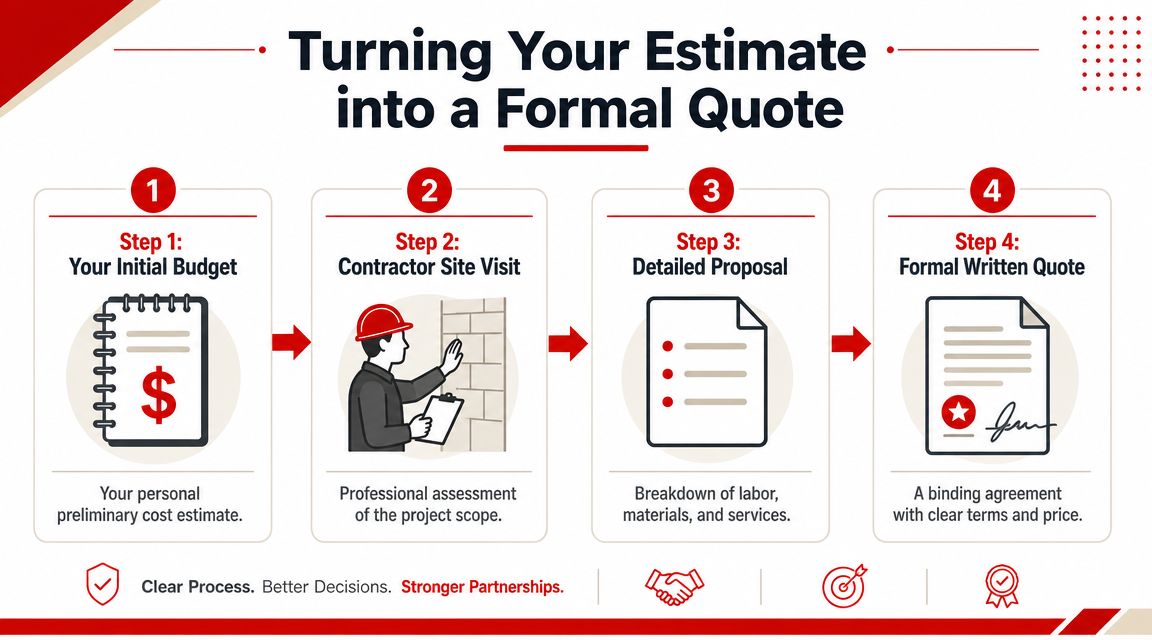
A formal quote should convert your rough budget into a defined scope, defined paint system and defined price. If it doesn't, you're still guessing.
What a written quote should lock in
A proper written quote should identify the areas to be painted, the included preparation, the number of coats, and the product system for each substrate. It should also state what has been excluded, such as timber replacement, plaster repairs beyond minor patching, or access equipment outside the original inspection assumptions.
That level of detail protects both sides. The owner knows what finish is being purchased. The contractor knows what standard is expected on site.
A strong quote will usually include:
- Scope of work for each room, elevation or surface group
- Preparation schedule such as washing, sanding, filling, caulking, scraping or spot priming
- Paint system details including brand families suited to the substrate
- Site conditions covering access, protection and staging
- Commercial terms including the fixed price and expected timing
When a contractor carries proper cover and stands behind the work, that should also be easy to verify. For example, if you're checking risk controls before approving a painter, it's worth reviewing how public liability insurance for painters applies to residential work.
One practical option for Melbourne owners is Newline Painting, a local painting company that provides written quotes, uses recognised brands including Dulux, Haymes, Taubmans, Berger and Wattyl, and backs workmanship with a 7-year warranty and $20M public liability insurance. That matters because the quote isn't only about price. It's also about accountability once the job starts and after handover.
If you want a firm number instead of a generic calculator range, request a free on-site quote from Newline Painting or call 1300 044 206. The site visit can confirm the scope, the right paint system, and the fixed price for your Melbourne property.