
For a professional exterior repaint in Melbourne, many homeowners budget $8,000 to $15,000 for a standard 3-bedroom home, but the swing comes from size, condition, and access. As a broad pricing benchmark, exterior work commonly sits around A$1,200 to A$2,700 per 1,000 square feet of paintable area, or roughly A$1.50 to A$4 per square foot, and that total rises fast once prep, height, and difficult surfaces come into play.
If you're reading quotes for the same house and one is far lower than the others, that's usually where the confusion starts. On paper, it can look like you're buying the same repaint. In practice, one quote may include full wash-down, scraping, sanding, gap filling, spot priming, two finish coats, and careful trim work, while another only prices a basic repaint over whatever's there now.
That difference matters in Melbourne. A weatherboard in Brighton with flaking paint and salt exposure is a different job from a cleaner brick veneer in Camberwell. A Hawthorn Federation home with ornate gables, timber fretwork, and delicate sash windows is different again. The price gap usually isn't about paint tins. It's about labour, prep standard, substrate, and access.
Table of Contents
- Understanding Your Exterior Painting Quotes
- Melbourne Exterior Painting Costs by House Size
- The 5 Key Drivers of Your Exterior Painting Cost
- How Professional Painters Price a Job
- How to Compare Painting Quotes in Melbourne
- 3 Ways to Get the Best Value on Your Paint Job
- Get a Fixed-Price Quote You Can Trust
Understanding Your Exterior Painting Quotes
Most homeowners hit the same problem. Three painters walk around the house, all nod at the same peeling boards and tired eaves, then the numbers land days later and they're nowhere near each other.
That happens because exterior painting quotes often hide the true scope inside short wording like “full prep and paint”. On one house, that might mean a wash, light sand, spot prime, and two acrylic topcoats. On another, it should mean heavy scraping, failed caulk removal, timber repairs, stain-blocking primer on weathered knots, full masking, and far more labour.
In Melbourne, housing stock makes this worse. A rendered wall in South Yarra, old weatherboards in Albert Park, and painted brick in Northcote all need different preparation and coating choices. Two houses with similar floor area can have very different exterior house painting cost because the paintable envelope, not just the floor plan, drives the workload.
Practical rule: If two quotes are far apart, assume the prep scope is different until someone proves otherwise in writing.
Published cost guides back that up. A common benchmark is A$1,200 to A$2,700 per 1,000 square feet of paintable exterior area, aligning with roughly A$1.50 to A$4 per square foot for exterior work, while prep alone commonly accounts for 20% to 30% of the overall budget and labour often makes up 60% to 70% of total cost according to HomeAdvisor's exterior painting cost breakdown.
What works is a quote that tells you exactly what gets washed, scraped, filled, primed, and top coated. What doesn't work is comparing only the final number and assuming every painter has priced the same standard.
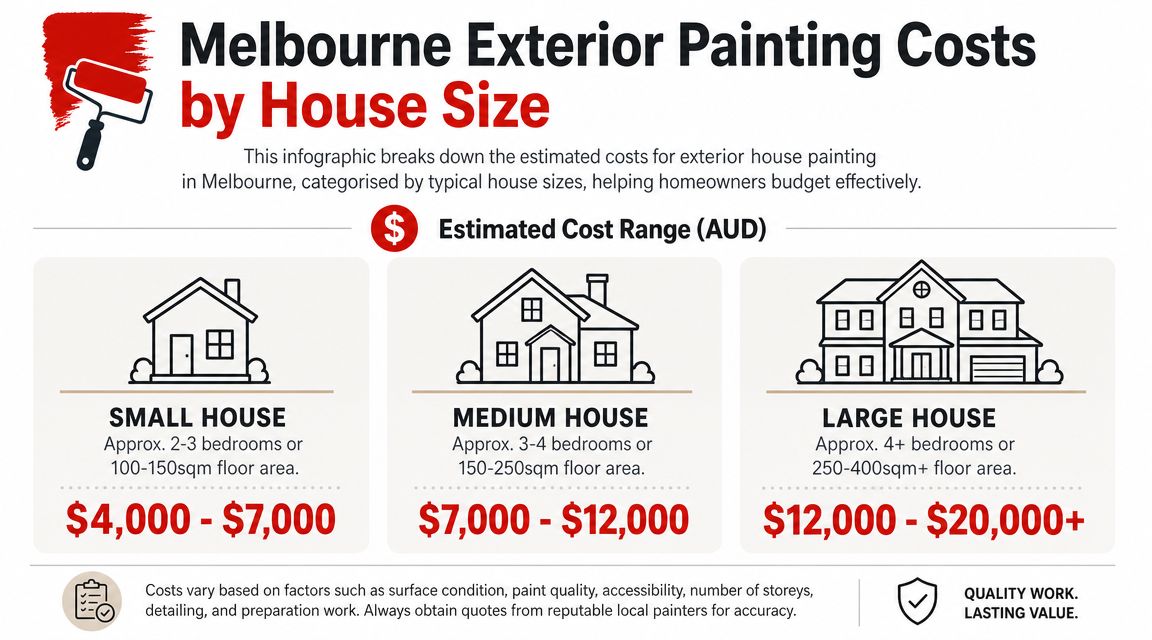
Melbourne Exterior Painting Costs by House Size
A small house can cost more to paint than a larger one if the outside is fussy, weathered, or hard to reach. I see that often in Melbourne. A neat brick veneer with wide side access is usually straightforward. A smaller Federation home in Hawthorn with timber fretwork, narrow paths, and high gable ends is slower from the first wash-down to the last coat.
Small single-storey homes
Small single-storey homes usually sit at the lower end of the market because setup is simpler, ladder work is easier, and there is less wall area overall. That applies to a compact weatherboard in Richmond, a plain brick veneer in the eastern suburbs, or a unit with clean access around all sides.
The catch is trim.
A small home with basic fascias and a couple of standard windows paints much faster than a period cottage with battens, verandah posts, timber sashes, corbels, and decorative gables. On weatherboards, every joint, edge, and failed patch of old paint adds hand work. In bayside areas like Brighton, salt and exposure often leave boards and trims in rougher condition, which pushes labour up even when the footprint is modest.
Garden access changes the maths too. Tight side setbacks, dense hedges, pergolas, or paths that will not take trestles safely can slow a crew more than owners expect.
Medium family homes
This is the range where quotes spread out the most. Many Melbourne homes look similar from the street, but the outside workload can be very different once you count window trim, eaves, gables, garage doors, fencing lines near walls, and mixed materials such as rendered sections beside timber cladding.
A standard three-bedroom family home can be a clean repaint. It can also turn into a heavier job if the south side is chalking, the sills are bare in places, or the rear extension has awkward access over decks and landscaping. Floor plan alone does not explain the price well. The painted envelope does.
If you want an early ballpark before booking site visits, Newline Painting has a painting cost calculator for Australia that gives a rough starting point. Use it to frame the budget, then expect the final quote to change once someone checks the condition of the timber, the number of detailed elements, and how the crew will reach each elevation.
Window count also matters more than many owners realise. More windows means more masking, more cutting-in, and more time on reveals and sills. If you are also pricing exterior cleaning as part of your maintenance planning, Pine Country's guide to window cleaning prices shows how access and window quantity affect service costs in a similar way.
Larger and taller homes
Height changes production speed straight away. Two-storey and three-storey homes need more setup, more careful ladder work, and in many cases scaffold, boom access, or extended platform time. That cost is real because it adds labour hours before much paint goes on.
Larger homes also tend to have more of everything. More downpipes, more windows, longer fascia runs, wider eaves, and bigger rear elevations that owners do not always account for when they estimate from the front street view. A tall townhouse on a sloping block can price above a broader single-storey home because every stage takes longer and access gear has to be factored in.
Older prestige homes in suburbs like Kew and Hawthorn are a good example. Delicate upper-level timberwork, stained glass surrounds, and detailed brackets around verandahs can make a large exterior repaint slow and methodical. By comparison, a newer home with flat rendered walls and clear access may cover more square metres but still move faster.
The practical takeaway is simple. House size sets a starting point. In Melbourne, the final cost usually shifts on three things tied to the house itself: what the exterior is made from, how much detailed trim it has, and how hard it is to get painters safely onto every surface.
The 5 Key Drivers of Your Exterior Painting Cost
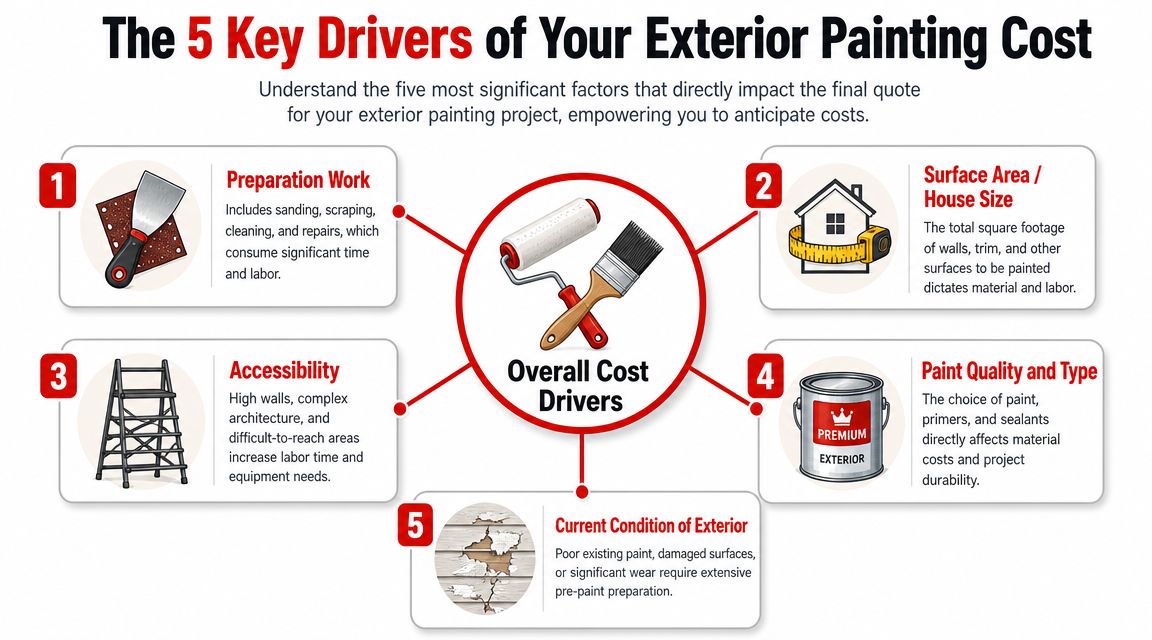
Two Melbourne houses can look similar from the street and come in thousands apart once the quote is written. A brick veneer in Bentleigh with clear side access is one job. A weatherboard in Brighton with peeling south-facing boards, salt exposure, and tight gaps to the boundary is another. The price gap usually comes back to five drivers.
1. Preparation work
Preparation is where a lot of the core labour sits. Washing, scraping, sanding, gap filling, caulking, masking, and priming can take as long as the painting itself on older exteriors.
The difference shows up fast from suburb to suburb. A Glen Waverley home with sound trim and light chalking might only need a wash, spot sand, and patch prime. A bayside weatherboard with loose paint and brittle putty can need days of scraping and feather sanding before the first finish coat is even possible. If those edges are not removed properly, the new paint bridges over failure underneath and lifts far sooner than it should.
This is why cheap quotes often fail on older homes. The painter has not allowed enough hours for prep, or has assumed the existing coating is sound when it is not.
2. Repairs before paint starts
Exterior paint needs a stable surface. If timber is rotten, joints are open, or sealant has failed, those defects need repair before the coating system goes on.
This catches owners out on older housing stock. On a Federation home in Hawthorn, you might start with what looks like a standard repaint and then find soft sill noses, split glazing beads, and loose verandah trim once the failed paint is removed. On weatherboards, lower boards and window surrounds are the common trouble spots because they hold moisture longer.
The better quotes deal with this clearly. They either allow for likely repairs up front or separate them as a listed variation item so there is no argument once the job starts. If you are pricing a timber exterior, detailed weatherboard house painting work should reflect the condition of the boards, not just the footprint of the house.
3. Surface type and absorbency
What the house is made from changes the system, the labour, and the amount of paint used.
Timber trim, rendered walls, bare masonry, previously painted brick, and fibre cement all behave differently. Porous surfaces usually need more washing, more product, and a primer that suits the substrate. Painted brick can look straightforward from the footpath, but if the surface is powdery or holding moisture, the coating choice becomes more specific and the prep gets slower. Smooth, stable cladding is faster. Rough masonry and detailed trim are not.
Industry guidance in Hover's breakdown of exterior painting cost drivers makes the same point. Substrate condition and porosity shift both preparation and coating requirements.
A useful comparison sits outside painting too. Pine Country's guide to window cleaning prices explains how a job that looks simple from the street changes once access and surface condition are factored in.
4. Access, height, and site setup
Access affects production speed every day of the job. Tight side paths, steep blocks, rear extensions, glass roofs, heavy planting, and high gables all slow setup and restrict how safely painters can move.
A single-storey home with room around the perimeter is usually straightforward. A similar-sized house on a sloping block with narrow access, second-storey dormers, and a conservatory below the work area is slower and more expensive because the setup is harder and the risk is higher. Sometimes ladders are enough. Sometimes scaffold is the only sensible way to get clean lines and proper coverage without damaging roofing or garden beds.
Here's a short video that gives a useful visual sense of what goes into exterior pricing and scope:
5. The paint system you specify
The paint system matters because it has to match the substrate and the exposure. The most expensive product is not automatically the right one.
Melbourne weather puts that into focus. South-facing walls stay damp longer. West-facing timber cops more UV. Bayside homes deal with more salt and wind-driven moisture. A proper system might include spot priming to bare timber, a stain-blocking primer on tannin-prone areas, masonry sealer on porous surfaces, and two finish coats suited to the material underneath. That is very different from a quote that says "paint exterior" and leaves the rest implied.
At Newline Painting, the practical approach is to list the system in writing, including prep, primers where required, and finish coats, using recognised paint lines such as Dulux, Haymes, Taubmans, Berger, or Wattyl. That makes it easier to compare quotes properly because you can see what each painter has allowed for.
How Professional Painters Price a Job
A proper exterior quote is built backwards from labour. Before a painter puts a number on the page, they work out how many hours the job will take, where the slow parts are, and how much uncertainty sits in the prep.

Fixed price is usually the clearest option
For most Melbourne homes, fixed-price quoting is the right format. The painter inspects the property, measures the paintable areas, checks condition, allows for setup and clean-up, then prices the whole scope as one job. That gives the owner a clear number and puts the responsibility on the painter to assess the house properly before work starts.
It only works if the scope is written clearly.
Older homes prove the point. On weatherboard painting, the visible size of the house tells only part of the story. A Brighton weatherboard with flaking south-side boards, open joints, and patched repairs can take far longer than a larger brick veneer in a newer estate. A Hawthorn Federation home can also blow out labour hours because of narrow eaves, turned posts, brackets, and layered trim that all need brushwork rather than fast roller work.
A fixed price only helps if the scope is fixed too. If the quote is vague, the number is vague.
Per square metre and day rate still matter
Even when the client sees one total figure, painters usually calculate it using a few pricing methods in the background.
One is area. Measured surface area helps estimate how much paint, primer, masking, and labour a house is likely to need. It is a useful check, but it never stands on its own. Two homes can have similar wall area and completely different pricing because one is smooth rendered brick with easy ground access, while the other has peeling timber, sash windows, and a steep block that slows every stage of the job.
The second is production time. Painters know roughly how many square metres a crew can wash, prepare, prime, and coat in a day, then adjust that rate for detail and condition. Delicate trim, heavy scraping, lead-safe procedures on older substrates, and awkward access all drag production down. That is why a cheap quote on an older exterior often means the painter has allowed unrealistically light prep.
Day rates also have a place, usually for uncertain repair work. If scraping starts and hidden rot shows up under failed filler or old joints open right through, it can be hard to lock in an exact labour figure beforehand. In that case, some painters will separate the repaint from repair variations, or price restoration work by the day with materials listed separately.
For a full exterior repaint, though, fixed pricing is still what most owners want. The better quotes use area, labour days, prep intensity, and material allowances behind the scenes, then present one figure with clear assumptions, exclusions, and a process that matches the house in front of them.
How to Compare Painting Quotes in Melbourne
A house in Brighton with peeling weatherboards and salt exposure should not be priced the same way as a newer brick veneer in Craigieburn with wide, clear access. If two quotes are far apart, the gap usually comes from preparation, access, and how much detail work the painter has allowed for. That is what you need to compare.
A low number can still look reasonable on paper. The problems usually show up later, when paint lifts off weathered timber, old edges print through, or detailed trim starts failing first because the prep was light.
What a proper quote should spell out
A quote worth comparing needs enough detail to show how the painter plans to handle your actual house, not a generic exterior.
Look for these items:
- Surface preparation. Washing, scraping, sanding, filling, caulking, gap sealing, masking, and whether failed paint is taken back to a firm edge.
- Repairs and allowances. Whether minor timber repair is included, excluded, or treated as a variation if hidden rot appears after scraping.
- Primer and undercoat details. Spot priming bare timber, stain-blocking where needed, and the right primer for masonry, metal, or glossy old trim.
- Coat count. One finish coat and two finish coats are priced very differently. The quote should state this clearly.
- Paint brand and product line. “Premium exterior paint” is too vague. The system should name the products being used.
- Included items. Walls, fascias, soffits, eaves, windows, doors, downpipes, garage doors, balustrades, and gates where relevant.
- Exclusions. Anything left out should be written down before work starts.
On older Melbourne homes, this detail matters. A Hawthorn Federation home with ornate brackets, sash windows, and layered old coatings can take far longer to prepare than a plain brick house of similar size. If the quote does not reflect that, it is probably missing labour somewhere.
Sample exterior painting quote breakdown
| Item | Description | What to Verify |
|---|---|---|
| Prep | Wash-down, scrape loose paint, sand edges, fill and caulk | Is prep described in detail or just mentioned broadly? |
| Repairs | Minor timber repairs or patching before primer | Are repairs included, excluded, or treated as variations? |
| Primer | Spot priming bare areas and problem substrates | Is the primer type matched to timber, masonry, or stains? |
| Topcoats | Exterior finish coats to nominated areas | Does the quote state the number of coats clearly? |
| Paint system | Brand and product line for all painted surfaces | Are specific products named, not just generic paint wording? |
| Access | Ladders, elevated work setup, protection, masking | Has difficult access been recognised in the scope? |
| Cleanup and handover | Site tidy, debris removal, final inspection | Is final walkthrough or sign-off included? |
Questions worth asking before you sign
Good painters should be able to answer direct questions without dodging the detail. If the answer is verbal, ask for it in writing.
Ask these before you commit:
- Are you insured? Ask for proof of cover. Checking a painter's public liability insurance details is a sensible first step before anyone starts on site.
- What prep is included? Ask them to show you the exact line items.
- What paint system are you using? Brand, primer, and finish coats should all be named.
- How are repairs handled? You need to know what happens if rotten timber or failed filler turns up once the old paint comes off.
- Do you offer a workmanship warranty? A written warranty gives you a clear standard to refer back to.
- Who supervises the job and does the final walkthrough? This matters on larger homes and on detailed period exteriors.
One more check helps. Compare the assumptions behind each quote, not just the total. If one painter has allowed for full wash-down, thorough scraping, two finish coats, and tricky second-storey access, and another has written three vague lines with no product names, those quotes are not pricing the same job.
For reference, Newline Painting offers a 7-year workmanship warranty, carries $20M public liability insurance, and uses written quotes that set out scope, preparation, paint system, and timelines. That is a useful benchmark for the level of detail and accountability you should expect.
3 Ways to Get the Best Value on Your Paint Job
Getting better value doesn't mean squeezing the quote until someone removes the important parts. It means spending on the items that affect lifespan and simplifying the parts that don't.
Choose where to spend and where to simplify
Start with prep. If the substrate is failing, spend there first. A lower-sheen acrylic topcoat over poor prep is still poor value. A well-prepared surface with a sensible premium system usually performs better than an expensive paint applied over loose or chalky material.
Then look at scope. You may not need every minor outbuilding, side fence, or old metal shed painted in the same stage as the house. Separating essential house protection from secondary items is often a cleaner budgeting decision than downgrading the coating system on the main structure.
A few practical ways to control cost without compromising the job:
- Clear access before the crew arrives. Move outdoor furniture, trim back plants, and clear paths so painters can work efficiently.
- Bundle similar works sensibly. If fascias, eaves, and windows are all due, doing them together is usually more efficient than staging them across separate visits.
- Be realistic about colour changes. Major colour shifts can require more work to cover evenly, especially on trim and porous surfaces.
Spend on adhesion, coverage, and durability. Save on unnecessary extras, not on the foundation of the job.
If you're unsure where to trim scope, ask the painter which items protect the building and which are mostly cosmetic. That's usually the most useful budget conversation you can have.
Get a Fixed-Price Quote You Can Trust
A good exterior quote should explain the work, not just total it. If the scope covers proper prep, the right primer, suitable topcoats, safe access, and a clear finish standard, you're in a much better position to compare apples with apples.
That matters even more on older Melbourne homes. Weatherboards, ornate trims, and exposed coastal facades punish vague quoting. If a painter can't explain why the job costs what it costs, they probably haven't inspected it thoroughly enough.
Insurance and accountability matter too. The same logic applies across trades. If you're comparing contractors more broadly, this article on bonded vs insured tree services is a useful reminder that cover, responsibility, and written scope are part of value, not just admin.
For homeowners who want certainty, Newline Painting works from a detailed on-site assessment through to final walkthrough and backs workmanship with a 7-year warranty. The company is Melbourne-based, carries $20M public liability insurance, and writes fixed-price quotes that set out prep standards, paint system, and exclusions clearly.
If you want a clear written quote for your exterior repaint, request a free on-site assessment from Newline Painting or call 1300 044 206. You'll get a fixed-price scope that explains the preparation, coating system, and what is and isn't included, so you can compare quotes properly.