
You're probably in the same spot most Melbourne homeowners hit before a repaint. You've narrowed the colour down, then walked into a paint store or opened a few tabs and realised the bigger question isn't the colour at all. It's the brand, the product line, the finish, and whether the paint you choose will still look right after a few summers, a wet winter, and normal wear in a lived-in home.
That matters more than people think. A paint job isn't just decoration. On a weatherboard exterior, it's part of the protection system. In a bathroom, it affects how well walls cope with steam and cleaning. In a rental, apartment, or pre-sale repaint, it affects how tidy and consistent the whole place looks when light hits every patched wall and roller line.
Australia has a large, established paint sector. The Australian paints market was valued at AUD 2.62 billion in 2025, with projected growth to AUD 3.26 billion by 2035. That scale is one reason the best paint brands australia question keeps coming up. Brands such as Dulux, Haymes, Taubmans and Wattyl compete hard on finish quality, durability and suitability for Australian conditions.
This guide looks at those brands from a painter's perspective. Not just who wins consumer ratings, but which paints behave well on the wall, which ones suit bathrooms, weatherboards, trims and cabinets, and what ultimately gives you a better long-term result in Melbourne homes.
Table of Contents
- Choosing a Paint Brand in Australia
- How Professionals Judge Paint The Newline Painting Criteria
- The Main Contenders A Comparison of Top Paint Brands
- Matching the Right Paint to Your Melbourne Project
- A Quick Guide to Paint Finishes From Matte to Gloss
- Why a Premium Brand Matters for Your Professional Paint Job
Choosing a Paint Brand in Australia
Choosing paint usually starts with colour cards and ends with second-guessing. That's normal. Homeowners rarely repaint often, and the shelf labels don't tell you which product will hold up on a west-facing weatherboard in Melbourne, which one lays off cleanly on a living room wall, or which one is going to show every patch and sanding mark.

The practical answer is that there isn't one best brand for every job. There's a best fit for the substrate, the room, the level of wear, and the amount of preparation underneath it. A premium product over poor prep still fails. A decent system over solid prep usually performs better than people expect. The best jobs get both right.
In Melbourne, brand choice matters because the conditions are mixed. Exterior paint has to handle UV, rain, wind, and temperature swings. Interiors have different problems. Hallways get bumped up by bags and furniture. Bathrooms trap moisture. Apartments often need low-odour products and tidy application because people are living in them during the job.
What homeowners usually get wrong
A lot of buyers focus on the label and ignore the full system. The paint brand matters, but so do these details:
- Surface condition: Cracks, flaking edges, chalky exteriors and old water staining need proper treatment before topcoats go on.
- Product match: Interior wall paint, enamel for trim, moisture-resistant coatings and exterior systems all do different jobs.
- Finish selection: Low sheen, matte and semi-gloss won't forgive the same preparation standard.
- Application behaviour: Some paints level out beautifully. Others can drag, flash or show lap marks if they're rushed.
Practical rule: Don't choose paint the way you choose a cushion colour. Choose it like part of the building fabric.
If you want a simple starting point before you compare brands, this guide on how to choose the right paint is a useful companion. It helps narrow the decision before you get into specific product lines.
The shortlist most Australians compare
For most residential repaints, the conversation usually comes back to Haymes, Taubmans, Dulux and Wattyl. They're established names, widely recognised, and each has product ranges suited to interiors, exteriors and specialty work.
The smarter question isn't “Which is best?” It's “Which one is best for this surface, in this house, with this level of prep?”
How Professionals Judge Paint The Newline Painting Criteria
Professionals don't judge paint by marketing copy. They judge it by how it behaves on site, how predictable it is across different surfaces, and how well it holds up after handover.
A client usually sees colour and finish. A painter sees something else first. Open time, flow, opacity, consistency from tin to tin, how sharply it cuts in, whether it drags on warm plaster, and whether it settles into a smooth film on trims.
Application matters as much as the label
A paint can have a good reputation and still be the wrong choice for a particular job. On occupied homes, ease of application matters because tidy, controlled work reduces disruption. In stairwells, apartment hallways and furnished rooms, you want products that cut cleanly, roll evenly and don't fight the painter all day.
Professionals tend to assess paint through a few practical filters:
- Coverage consistency: A reliable product hides patches and colour changes more evenly across a full wall or ceiling.
- Workability: Some paints stay workable long enough to maintain a wet edge. That helps reduce lap marks and patchiness.
- Finish quality: Good paint should dry to an even sheen and not highlight every repair more than necessary.
- Recoat behaviour: On larger jobs, a system needs to accept the next coat properly and stay consistent room to room.
Durability is about the whole system
Homeowners often use “durable” to mean hard to mark. That's only part of it. Durability also means how the film handles cleaning, steam, sunlight, movement in the substrate and seasonal expansion on exterior timber.
In Melbourne, that shows up clearly on older homes. Weatherboards cop sun on one elevation and moisture on another. Bathroom ceilings can look fine after painting, then reveal problems later if the wrong prep or coating was used. Trim paint might look crisp on day one but chip early if the substrate wasn't cleaned and keyed properly.
Good paint doesn't rescue bad preparation. It rewards good preparation.
Range depth matters on mixed-surface jobs
The more varied the project, the more valuable a broad product system becomes. A full house repaint can involve plaster, timber trim, doors, bathroom ceilings, metal balustrades, masonry, fencing and garage concrete. It helps when one brand offers compatible options across those surfaces, especially for specification and colour consistency.
That matters for:
- House painting with mixed old and new substrates
- Interior repainting where patched plaster and existing coatings vary
- Exterior painting on weatherboards, brick and rendered walls
- Cabinet and trim work where hardness and smoothness matter
- Bathroom, fence, driveway and garage floor painting where specialised coatings are often needed
What professionals avoid
The products that cause headaches usually have one or more of these issues:
- Poor levelling: Brush and roller texture stays too prominent.
- Inconsistent sheen: Touch-ups or repaired areas stand out.
- Weak body: The film feels thin and less forgiving over colour change.
- Limited system support: Good wall paint, but fewer strong options for trims, exteriors or specialty substrates.
That's why painters tend to stay with a small group of dependable brands rather than chasing whatever is cheapest on the day.
The Main Contenders A Comparison of Top Paint Brands
Independent consumer ratings give a useful starting point, but they don't tell the whole story. They tell you which brands people feel good about after purchase and use. Painters then add another layer, which is how those products behave during preparation, application and finishing.
In Canstar Blue's 2025 paint ratings, Taubmans and Haymes Paint were the top picks, both earning five stars for overall satisfaction. Taubmans rated strongly for durability and value, while Haymes also received five stars for quality of finish and ease of application. Past winners listed there include Dulux in 2024 and Haymes in 2023 and 2022, which tells you the top end of the market is competitive rather than fixed.
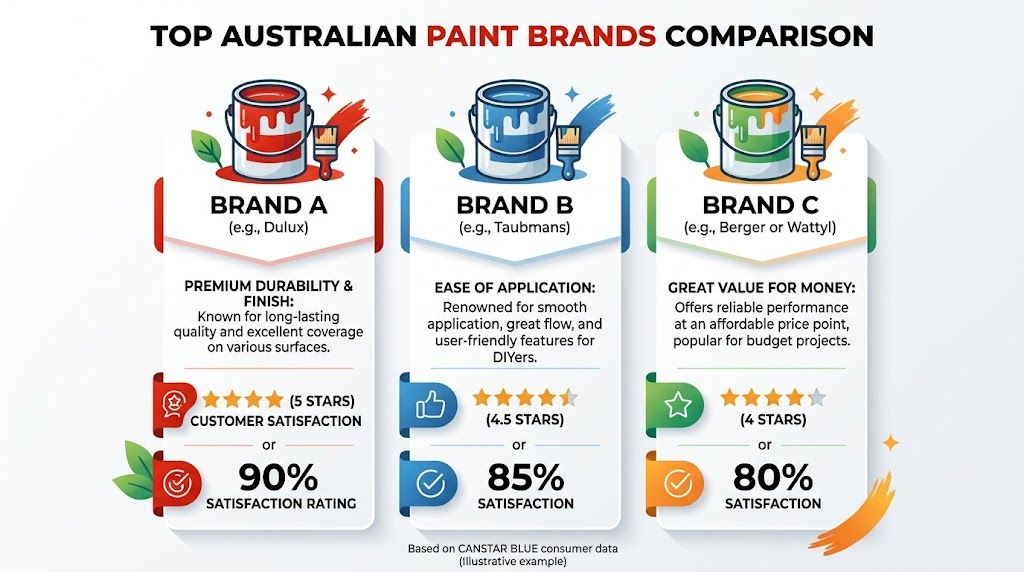
Quick comparison table
| Brand | Best known for | Painter's perspective | Best fit |
|---|---|---|---|
| Haymes | Finish quality, ease of application, broad system depth | Consistent, smooth, strong option for premium residential work | Interiors, exteriors, trims, multi-surface projects |
| Taubmans | Durability, value, strong all-round consumer performance | Good balance between cost and dependable performance | Rentals, family homes, broad repaint work |
| Dulux | Widely available product lines and familiar systems | Safe specification choice with strong retail access | Busy homes, common repaint cycles, widely stocked projects |
| Wattyl | Established name with recognised durability credentials | Can suit practical work where system familiarity matters | General repainting and selected exterior/interior use |
Haymes
Haymes has a strong reputation among painters who care about finish quality. In Australian commentary summarising Canstar Blue results, Haymes stands out for all-round performance, especially where ease of application and value line up with finish expectations. Another Australian source aimed at homeowners and painters notes that Haymes offers over 5,000 colours and coatings across woodcare, concrete, render, textures, interior and exterior systems, with the Ultra Premium range noted for smooth finish and durability.
That range depth matters on real jobs. If you're repainting a whole house, it's useful when one brand can cover living areas, weatherboards, timber details, masonry, and concrete-related surfaces without jumping across multiple systems.
From a painter's perspective, Haymes is often a strong fit when:
- Finish quality is the priority
- Colour control matters
- The project includes several substrates
- You want a premium-spec residential result
What doesn't suit every client is simple. If convenience and broad retail pickup matter more than specification nuance, some homeowners still lean toward a more commonly stocked brand.
Taubmans
Taubmans is a practical contender and often gets underrated because people focus on Dulux and Haymes first. The Canstar Blue results position it strongly on durability and value, and that combination matters for households that want a solid repaint without feeling like they've overbought.
For painters, Taubmans can make sense on jobs where the brief is straightforward. Refresh the walls, improve wear resistance, keep the project sensible. That often includes rental properties, family homes, pre-sale preparation and rooms where easy maintenance matters more than chasing the last bit of premium feel.
Its appeal is usually this:
- Balanced spend
- Reliable residential performance
- Strong consumer confidence on value
- Suitable for broad repaint programs
If the brief is “make it look clean, even and durable without overcomplicating it”, Taubmans often stays in the conversation.
The limitation is that some clients and specifiers prefer other brands for premium-end perception or because their painter has deeper familiarity with another system.
Dulux
Dulux remains one of the most common names clients ask for, and that's not hard to understand. It's well known, widely available and has familiar ranges that many Australian homeowners recognise. In Melbourne, painters often hear specific product names from clients rather than just the brand itself. Washable interior systems and exterior weather protection ranges come up a lot.
From a practical point of view, Dulux is often the safe, familiar option. It suits homeowners who want easy access, clear product recognition and a product line that most painting crews already know how to work with.
Dulux is often chosen when:
- The homeowner wants a familiar brand
- Product availability matters
- The job involves standard residential walls, ceilings and exteriors
- A builder, property manager or owner wants straightforward specification
The trade-off is usually value perception. In the broader Australian comparisons referenced earlier, Dulux remains a top-tier brand, but it isn't always the strongest on value-for-money ratings.
Wattyl and other recognised names
Wattyl still belongs in the best paint brands australia discussion because it has long-standing recognition in the local market and remains one of the established names homeowners compare. It may not dominate every shortlist, but it's a credible option in the practical middle ground.
Beyond the biggest residential names, Australia's paint market also includes recognised players such as Berger, PPG Industries, Jotun, Norglass and others noted in market reporting earlier. Those names matter more often in specific coating categories, selected commercial work, or jobs where a specialist system is required rather than a standard full-house repaint.
For most Melbourne residential projects, the shortlist still comes back to this:
- Haymes for premium finish and broad system depth
- Taubmans for value and durable all-round use
- Dulux for familiarity, access and dependable residential systems
- Wattyl as an established alternative in the recognised top group
Matching the Right Paint to Your Melbourne Project
Brand matters. Matching the paint system to the room or surface matters more. The right product on the wrong substrate, or the right brand in the wrong finish, still leads to a disappointing job.

Interior walls in busy areas
Hallways, living areas, kids' bedrooms and stairwells need more than a nice colour. They need a washable, even-looking wall finish that won't show every mark after a few months.
A painter usually looks for a low sheen or similar interior wall system that balances appearance with cleanability. Very flat finishes can look great in the right room, but they're less forgiving in spaces where hands, bags and furniture regularly hit the walls.
Good choices here usually favour:
- Consistent coverage over patches and old colours
- Controlled roller finish
- Washability without a plastic-looking sheen
- Reliable touch-up behaviour where possible
For painted masonry or interior brick features, the substrate changes the system choice. This practical guide on how to paint brick walls is useful if part of your project includes raw or previously coated brick.
Bathrooms laundries and kitchens
These rooms fail early when people treat them like standard dry areas. Steam, condensation, frequent cleaning and grease change the specification. Bathroom ceilings in particular need careful prep if there's any existing peeling, mould staining or soap residue.
The paint itself needs to suit moisture-prone conditions, but the prep is what often decides whether the result lasts. Washing down, mould treatment where needed, sanding, spot priming and using the right topcoat sequence all matter.
What usually works best:
- Moisture-resistant wall and ceiling coatings
- Better ventilation before and after painting
- No shortcuts over peeling or unstable paint
- Higher-durability finishes where regular wiping is expected
Exterior weatherboards and masonry
Melbourne exteriors don't age evenly. North and west elevations take more punishment from UV. South-facing areas can stay damp longer. Older weatherboards move, joints open up, and previous coatings can fail in isolated sections first.
For that reason, exterior painting is rarely just about brand. It's about the full substrate repair and coating system. Sanding loose edges, replacing failed caulk, priming bare timber and choosing an exterior product line designed for UV and water exposure are the basics.
A broad coating system can help on these jobs. One Australian source notes that Haymes offers over 5,000 colours and specialised coatings across woodcare, concrete, render and industrial use, with the Ultra Premium range especially noted for smooth finish and durability, which makes it a practical option where a project includes several exposed surfaces at once.
If you want a quick visual on preparation and application standards, this video is a useful reference point before planning an exterior or full-house repaint.
West-facing weatherboards are often where cheap decisions show up first.
Cabinets trims doors fences and concrete
These surfaces need a different mindset. Wall paint isn't enough.
Trim and doors need harder-wearing enamels or trim-specific systems that level out cleanly and resist scuffing. Cabinets need careful degreasing, sanding, adhesion-focused primers and coatings suited to repeated handling. Fences need products appropriate for rough-sawn timber and outdoor exposure. Driveways and garage floors move into specialty coating territory, especially when durability and surface prep become more demanding.
A simple way to look at this:
| Surface | What matters most | Typical paint priority |
|---|---|---|
| Trim and doors | Smooth levelling and hardness | Semi-gloss or satin-style durable trim system |
| Cabinets | Adhesion and clean finish | Purpose-suited primer and durable topcoat |
| Fences | Penetration and weather resistance | Exterior timber coating system |
| Driveways and garage floors | Surface prep and coating compatibility | Specialty concrete or epoxy-type system |
A Quick Guide to Paint Finishes From Matte to Gloss
Clients often spend weeks choosing colour and only a few minutes choosing sheen. That's backwards. The finish changes how the paint looks in daylight, how much wall prep shows through, and how easy the surface is to wipe down.
A darker colour in matte can look soft and elegant. The same colour in a higher sheen can look sharper, harder and more reflective. Neither is automatically better. It depends on the room, the substrate and how much wear the area gets.
Paint Finish Comparison Guide
| Finish | Appearance | Durability/Washability | Best For |
|---|---|---|---|
| Matte | Soft, low-reflective | Lower washability than higher-sheen options | Ceilings, low-traffic rooms, surfaces with imperfections |
| Low sheen | Gentle lustre, balanced look | Good everyday practicality | Main interior walls, living areas, bedrooms, hallways |
| Satin | Noticeably smoother and slightly richer | Generally easier to wipe than flatter finishes | Some walls, trims, feature areas, practical family spaces |
| Semi-gloss | More reflective, crisp finish | Stronger washability and wear resistance | Doors, trims, skirtings, architraves, bathrooms |
| Gloss | High reflectivity, sharp look | Hard-wearing but shows imperfections | Feature joinery, selected trims, heritage detailing |
How sheen changes the result
Matte and low sheen are usually the safest choices for most interior walls because they don't exaggerate every plaster repair. In older Melbourne homes with patched surfaces, that matters. A high-sheen wall finish can make a decent wall look rough if the substrate wasn't corrected properly.
Semi-gloss and gloss work better on timber details, doors and some cabinetry because they give a harder, more washable film. They also highlight workmanship more aggressively. If a door has dents, filler ridges or sanding scratches, extra sheen won't hide them. It will do the opposite.
For style-led homes, finish choice also affects the architectural feel. If you're aiming for a coastal or Hamptons-style result, the way trims, walls and feature timber are balanced becomes part of the design language. This guide to Flascon's Hamptons building expertise is useful for understanding how finish choices support the broader look of that style.
If you want a more room-by-room explanation of sheen selection, this overview of paint finishes and where to use them is a practical reference.
Higher sheen gives you more wipeability, but it also asks more from the surface underneath.
Why a Premium Brand Matters for Your Professional Paint Job
When you hire professional painters, the biggest investment usually isn't the tin. It's the labour, the preparation, the protection of floors and furniture, the patching, sanding, priming, masking, cutting in, and the time it takes to get an even finish across the whole home.
That's why premium paint matters. If the preparation is done properly, it makes little sense to top it off with a product that's harder to apply cleanly, less consistent in finish, or less suited to the surface. Better paint helps protect the labour that went into the job.
Where better paint helps
Premium residential paint tends to justify itself in the areas homeowners notice most:
- Smoother finish: Better levelling on walls, doors and trims.
- More predictable application: Fewer surprises during rolling, cutting in and recoating.
- Stronger system fit: Easier to match primers, wall coatings, trim coatings and exterior products within one specification.
- Better long-term appearance: Less chance of uneven sheen, weak-looking coverage or early disappointment.
That doesn't mean every project needs the highest-spec product available. A rental refresh, a quick pre-sale tidy-up and a long-term family home repaint don't always need the same system. The point is matching the product to the brief without undermining the result.
What doesn't work
The cheapest path usually fails in familiar ways. People save on the coating, then spend more time on extra coats, touch-ups, or repainting earlier than expected. Or they choose a finish that looks fine in the store and wrong once it hits real walls with daylight across them.
The other common mistake is buying by brand name alone. A good brand still has entry-level and premium lines. The exact product matters. So does the substrate prep underneath it.
For most professional repaints, the sensible approach is simple. Use a recognised brand, choose a product line that suits the room or exterior surface, and don't cut corners on preparation.
If you're comparing options for a house repaint, apartment refresh, pre-sale tidy-up, bathroom upgrade, cabinet repaint or exterior restoration, Newline Painting can help you choose a paint system that fits the surface, the finish you want, and the way your property is used. You can request a free on-site quote, get practical colour advice, and see a clear written scope covering preparation, coatings and timing before the job starts.