Interior painting in Melbourne typically sits around $2,000 to $6,000 for a standard home, with baseline pricing often framed at about $21.50 to $64.60 per square metre. The main reason quotes vary is simple: labour and preparation usually make up 60% to 90% of the total, so the final number is driven more by surface condition, access, and scope than by paint alone.
If you're comparing two quotes right now and wondering how both can be for “the same job” while landing far apart, that's normal. One painter may be pricing walls only. Another may be including ceilings, doors, patching, sanding, stain-blocking primer, floor protection, furniture moving, and a proper two-coat system.
That difference shows up constantly across Melbourne. A South Yarra apartment repaint can look straightforward until access, lifts, occupied rooms, and tight masking around cabinetry are factored in. A Federation home in Kew can have the opposite problem. Bigger wall area, ornate cornices, old plaster, architraves, panel doors, and timber trims all add labour well before the first topcoat goes on.
The useful question isn't just how much does interior painting cost. It's what the quote includes, what has been left out, and which parts of the job will decide whether the finish still looks right a few years from now.
Table of Contents
- Why Interior Painting Quotes Vary So Much in Melbourne
- Melbourne Interior Painting Cost Benchmarks
- What a Professional Painting Quote Actually Includes
- Common Factors That Increase Painting Costs
- How to Get an Accurate and Reliable Quote
- Budgeting for a Quality Finish That Lasts
Why Interior Painting Quotes Vary So Much in Melbourne
Interior painting quotes vary because most jobs aren't priced by room count alone. They're priced by paintable surface area, preparation time, included components, and site conditions.
A common example is a homeowner in Hawthorn or Malvern sending the same room photos to two painters and getting very different prices back. One quote may assume clean walls, no repairs, no ceiling, no trim, and vacant access. The other may allow for crack filling, sanding, stain-blocking, protection of furnished rooms, and enamel work to skirtings and doors. On paper, both are for “one bedroom”. In practice, they are not the same scope.
Australia-wide cost guides give a useful baseline, but they also explain why the spread is wide. Interior painting is commonly benchmarked at about $2 to $6 per square foot, or roughly $21.50 to $64.60 per square metre, with a typical whole-home average around $2,022 and a common project range of $965 to $3,088 according to interior painting cost benchmarks published by HomeAdvisor. Those figures become far more meaningful once you realise they shift as soon as ceilings, trim, and extra preparation are added.
Practical rule: If one quote only mentions “paint walls” and another lists walls, ceilings, woodwork, patching, protection, and clean-up, you're not comparing price. You're comparing two different jobs.
Melbourne homes exaggerate this difference. A newer apartment in Richmond may have fewer trims and simpler wall lines, but access rules, basement parking, booked loading zones, and occupied living conditions can slow production. An older home in Camberwell may be easier to access, but old plaster movement, decorative cornices, and previous coating failure can push labour up quickly.
The finish you choose matters too. Higher-sheen enamels on trims and doors show prep defects more clearly than acrylic low-sheen on walls, so the standard of filling and sanding has to lift with the finish. If you're weighing sheen levels, this guide to paint finishes is useful because finish selection affects both appearance and labour tolerance.
Melbourne Interior Painting Cost Benchmarks
The cleanest way to budget is to use three benchmarks together: per square metre, per room, and by overall home size. None is perfect on its own, but together they give a realistic starting point.
The main benchmarks homeowners use
The broadest baseline in Australia is about $21.50 to $64.60 per square metre, with a typical whole-home average around $2,022 and a common range of $965 to $3,088, based on Australian interior painting cost guide figures gathered by HomeAdvisor. That's useful for early budgeting, especially when you only know the floor area.
Room-based budgeting gives a different lens. Recent industry cost guides place a single room at roughly $400 to $1,600, with a standard 1,000-square-foot home often falling between $2,000 and $6,000 and a 2,000-square-foot home between $4,000 and $10,000 in Allbright Painting's 2025 cost guide. Those ranges are broad because room condition, trim detail, and prep intensity move the number more than most clients expect.
If your project includes joinery rather than just walls, it helps to separate those budgets early. For example, many homeowners planning a kitchen update look into how much does it cost to paint cabinets as a standalone line item so they don't confuse cabinet refinishing with standard wall painting.
Typical interior painting costs in Melbourne
| Project Scope | Typical Price Range (incl. GST) |
|---|---|
| Single room | $400 to $1,600 |
| Standard 1,000-square-foot home | $2,000 to $6,000 |
| Standard 2,000-square-foot home | $4,000 to $10,000 |
| Whole-home average benchmark | Around $2,022 |
| Common whole-project range benchmark | $965 to $3,088 |
These figures are best treated as benchmarks, not fixed rates. A one-bedroom apartment in South Yarra can still price above expectation if it includes ceilings, doors, built-ins, heavy protection, and multiple return visits for occupied access.
A low headline rate can be accurate for a clean repaint with simple walls. It becomes misleading the moment the job includes trims, ceilings, repairs, or site restrictions.
Why benchmarks are only a starting point
The benchmark that catches many people out is the one about added surfaces. The same HomeAdvisor guide notes that adding walls, trim, and ceilings increases the effective rate to about $4.70 per square foot in its interior painting pricing breakdown. That's why a “full internal repaint” costs more than a wall-only refresh even in homes with similar floor plans.
This is also why online estimators are most useful at the early planning stage. If you want a fast budget before booking an inspection, this house painting cost calculator for Australia can help frame the likely scope. The actual number still needs an on-site check, especially in older Melbourne homes where wall condition and timber detail rarely show properly in photos.
What a Professional Painting Quote Actually Includes
A professional painting quote should read like a scope document, not a one-line price. If it doesn't separate surfaces and preparation, it leaves too much open to interpretation.
A proper quote is built by surface, not by guesswork
Good interior quotes are built from separate wall, ceiling, trim, and door allowances, not a single number based only on home size. One neutral source makes that point directly and notes that many contractors also work to a minimum project size of about $2,000, which explains why a small one-room job can price very differently from a broader repaint in this breakdown of how painters structure estimates.
That matters in Melbourne because many jobs are partial repaints. A property manager might want only the living areas and hallway done before a new tenancy. A vendor in Armadale may only need walls, ceilings, and front rooms refreshed before a campaign. A family in Northcote might do bedrooms now and the rest later. If the quote doesn't spell out each component, it's impossible to compare properly.
A written quote should usually identify:
- Walls with the number of coats and any primer requirement
- Ceilings including stain treatment if water marks are present
- Trim and woodwork such as skirtings, architraves, window frames, and doors
- Repairs to plaster cracks, dents, peeling areas, or failed previous coatings
- Protection and masking for floors, furniture, cabinetry, and adjacent surfaces
- Paint system including brand family and finish type, such as acrylic low-sheen or enamel
Preparation is where most of the work sits
Most homeowners look first at the paint brand. Painters look first at the substrate.
Preparation usually includes washing down, scraping loose material, gap filling, plaster patching, sanding, caulking, spot priming, stain-blocking where needed, and masking everything that shouldn't get coated. On a clean apartment repaint, this can be modest. In an older Edwardian or Federation home, it can dominate the job.
If you've ever seen flashing patches, roller lines, sinkage over filler, or old stains bleeding back through a ceiling, that's usually not a paint problem. It's a prep problem or a system problem.
The finish is only as good as the surface under it. Paint doesn't hide poor preparation. It highlights it.
This is also why very cheap quotes often fail in occupied homes. Protection takes time. Moving furniture takes time. Re-setting a room for the night takes time. None of that changes the colour on the wall, but it changes the labour content of the job.
For clients who want to verify that a contractor is properly covered before work starts, checking details like public liability insurance for painters is part of due diligence. That doesn't tell you how well they prepare, but it does tell you whether the business is operating with basic accountability in place.
Paint system and finish level
The quote should also identify what is being applied, not just that painting will occur. On interior work, that often means a stain-blocking primer where there has been water damage or nicotine bleed, followed by an acrylic wall finish in low-sheen or washable matte, plus a tougher enamel system on timber trims and doors.
Different finishes carry different labour expectations. Low-sheen walls are forgiving compared with higher-sheen woodwork. Dark colour changes often need more care to achieve a consistent film build and clean cut lines. White-on-white repaints can move faster, but only if the surfaces are already sound.
At Newline Painting, the jobs that run most smoothly are the ones where the quote clearly names the scope, prep standard, and paint system from the start. Using recognised systems from Dulux, Haymes, Taubmans, Berger, or Wattyl is only part of the story. Value sits in whether the quote has properly allowed for the work underneath those coatings.
Common Factors That Increase Painting Costs
Painting costs climb when the job stops being a simple repaint and becomes a repair, access, or detail-heavy project. In Melbourne, that happens often.
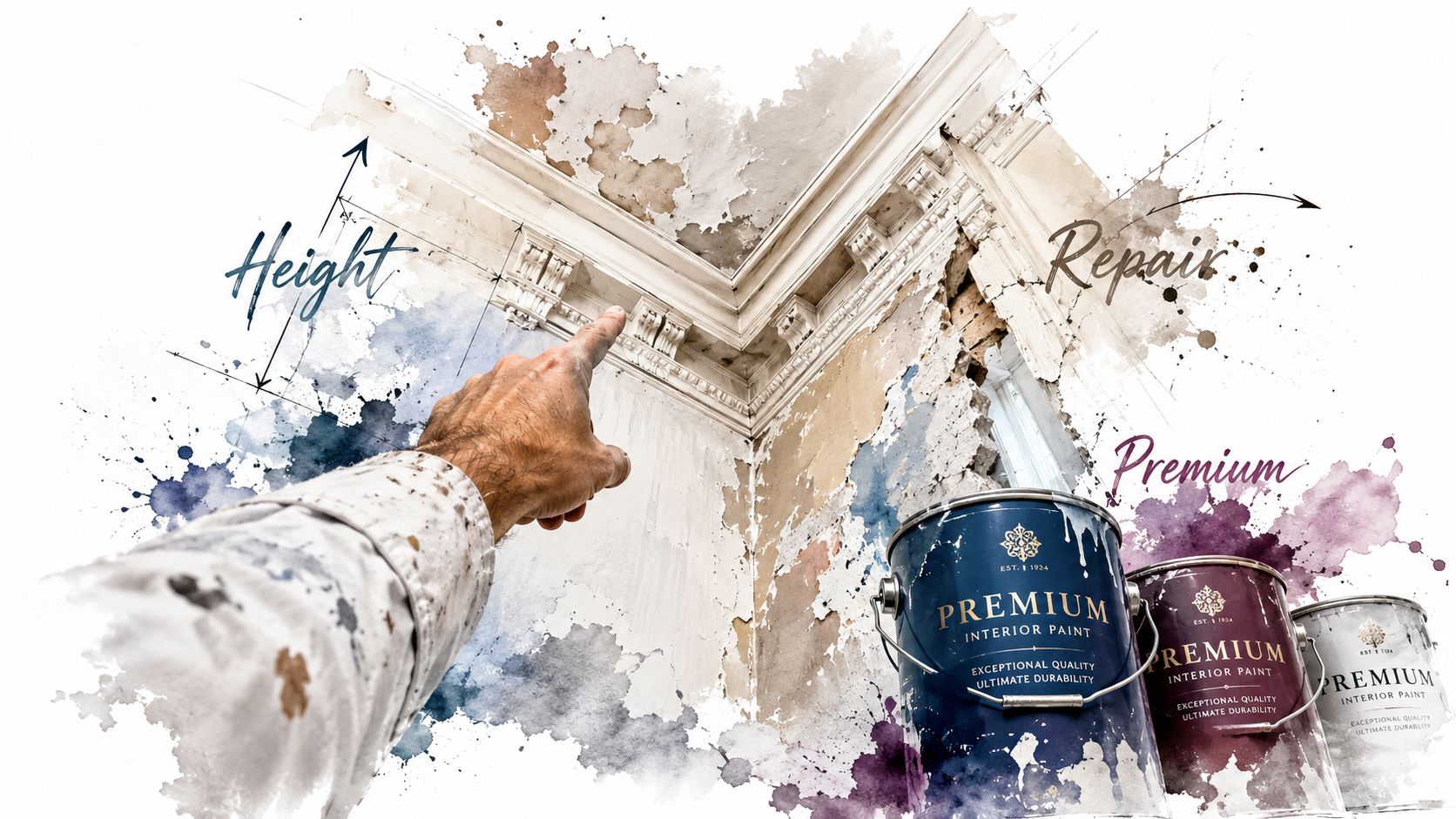
Surface condition changes the whole job
The most expensive interiors are rarely the biggest ones. They're usually the ones with the worst substrate.
The cost of repainting rises sharply when surfaces need patching, sanding, stain blocking, mould treatment, or crack repair before topcoats can be applied, as explained in this guide to interior painting costs and surface preparation. Once a job reaches that point, pricing often follows labour hours rather than paint volume.
A few examples from day-to-day quoting make this obvious:
- Water-damaged ceilings need more than a fresh coat. They often need scraping, sealing with a stain-blocking primer, patching, sanding, then full recoating.
- Settled plaster cracks in older homes can't just be painted over if the client wants them to stay closed and visually neat.
- Peeling previous coatings need removal and edge sanding or the new finish will telegraph every failure line.
- Mould-affected bathrooms and laundries need treatment and the right coating system, not cosmetic covering.
Heritage detail and difficult access
Melbourne's housing stock adds its own cost drivers. A period home in Kew or Albert Park may have ornate cornices, ceiling roses, panel doors, picture rails, deep skirtings, and layered old coatings. All of that slows cutting-in, sanding, filling, and enamel work.
Contemporary apartments can be just as awkward in a different way. Tight lift bookings, no loading access, strict building rules, and limited work hours don't make the painting harder technically, but they reduce production time and increase handling.
Older homes usually cost more because they ask for finer hands and more patience, not because they use dramatically more paint.
Occupied homes take longer
The hidden cost many owners underestimate is disruption management. Painting a vacant property is one thing. Painting around a family, tenants, pets, or staged furniture is another.
Common additions include:
- Furniture shifting room by room instead of open access
- Extra masking over stone tops, wardrobes, curtains, and floors
- Dust control in homes that are still being lived in
- Split scheduling where certain rooms must stay usable overnight
- Slower staging in properties being prepared for sale
That's why two homes of similar size in Brighton or Toorak can receive different quotes even when the wall areas are close. One might be empty and straightforward. The other may need careful sequencing so the occupants can keep using bedrooms, kitchen areas, or home offices.
How to Get an Accurate and Reliable Quote
The most reliable quote comes from an on-site inspection with a written scope. Anything else is only a budget estimate.
An on-site inspection is not optional
One recent source notes that many interior jobs now average $3,842.14 nationally and also points out that the occupied-home premium is real, with extra time for moving furniture, masking, dust protection, and staged scheduling materially increasing the quote in CertaPro's interior house painting cost guide. That's exactly why online calculators and photo-only estimates often miss the mark.
An on-site visit lets the painter check what photos usually hide:
- Hairline versus structural-looking cracks
- Water stains that need sealing
- Loose or chalky previous coatings
- Access limitations in apartments and narrow terraces
- Whether the home is occupied, partially occupied, or vacant
- How much woodwork is included
If you're managing several properties or want a consistent way to organise scope and measurements across jobs, tools like Exayard painting estimating software can help structure the estimating process. The key point is still the same. Software supports estimating, but it doesn't replace walking the site.
A useful visual overview of what to look for in a painter is below.
What to compare when you have multiple quotes
When three quotes land in your inbox, ignore the total for a moment and compare the wording line by line.
Look for these differences:
-
Included surfaces
Does the quote cover walls only, or walls plus ceilings, doors, skirtings, architraves, and window frames? -
Preparation standard
Is patching minor only, or are cracks, failed paint, stains, and sanding allowed for? -
Paint system
Does it identify primer where needed and specify the finish type, or just say “paint included”? -
Protection and clean-up
Does it mention floor covering, masking, furniture handling, and final tidy-up? -
Programme and access assumptions
Is the price based on vacant possession, or has the painter allowed for an occupied home?
If a quote is short on words, it's usually short on scope.
What gives a quote credibility
A credible quote doesn't need to be long for the sake of it. It needs to be clear enough that both sides know what will happen on site.
Practical signs of a reliable contractor include:
- Trade-qualified painters rather than casual labour with unclear supervision
- Current insurance and a willingness to provide details
- A workmanship warranty stated in writing
- Named paint systems from recognised brands
- A clear exclusions list so there are no surprises later
For Melbourne owners, agents, and builders, those checks matter because repainting is rarely just about colour. It affects timelines, tenant handovers, campaign launches, and whether the finish will hold up in lived-in conditions. Newline Painting, for example, works from written scope documents, carries $20M public liability insurance, and backs workmanship with a 7-year warranty. Those are the kinds of specifics worth comparing, regardless of which painter you choose.
Budgeting for a Quality Finish That Lasts
A durable interior repaint is usually not the one with the lowest starting figure. It's the one where the budget has allowed for the right preparation, the right coating system, and enough labour to apply it properly.
Cheap numbers usually hide labour
Industry cost guides estimate that professional labour and preparation make up 60% to 90% of total interior painting cost, which is why a standard 1,000-square-foot home can range from $2,000 to $6,000 in Allbright Painting's cost guide. This highlights the trade-off. A cheaper quote often means less preparation, less protection, fewer included surfaces, or a thinner scope around repairs.
That matters even more in Melbourne homes with old plaster, timber trims, moisture-prone rooms, or active households. If the prep is cut, the defects come back quickly. Flashing shows. Cracks reappear. Stains bleed through. Doors and skirtings mark more easily because the system wasn't built for the substrate.
Where value actually comes from
Good value in painting is usually found in a few simple things:
- Detailed scope so you know what's included before work starts
- Preparation that matches the condition rather than a generic allowance
- Appropriate paint systems for walls, ceilings, trims, and wet areas
- Clean site management in occupied homes
- A clear handover standard with defects checked before sign-off
If you're trying to keep overall property costs under control while coordinating repainting with a move, staging, or settlement, planning helps more than chasing the lowest trade quote. For people juggling multiple moving expenses at the same time, these expert strategies for a cheaper Sydney move are a useful reminder that scheduling and scope discipline usually save more than last-minute compromises.
A quality repaint should still look even, hold up to cleaning, and age properly across walls, ceilings, and woodwork. That's what you're really paying for.
If you want a clear, written interior painting quote based on the actual condition of your home, request a free on-site quote from Newline Painting or call 1300 044 206. We service Melbourne homes from apartments in South Yarra to period houses across the inner and eastern suburbs, and we'll itemise the scope so you can see exactly what's included.