
You've probably seen the pattern already. The deck still feels solid underfoot, but the boards have gone grey, the old coating is patchy, and water doesn't behave the way it used to. In Melbourne, that usually means the deck isn't just due for a cosmetic freshen-up. It's due for proper maintenance.
That's where most searches for deck staining companies near me go wrong. Homeowners often compare one quote against another as if they're buying the same job. They usually aren't. The real difference sits in prep, moisture management, stain selection, weather timing, and whether the contractor is thinking about the deck's next maintenance cycle, not just this one visit.
Table of Contents
- Why Your Melbourne Deck Needs More Than a Quick Stain
- How to Find Reputable Deck Stainers in Melbourne
- Vetting Credentials and Asking the Right Questions
- Decoding Quotes and Comparing Finishes
- Preparing for the Project and What to Expect
- Common Red Flags and Ensuring a Quality Outcome
Why Your Melbourne Deck Needs More Than a Quick Stain
A Melbourne deck needs more than a fast coat because the job is really about timber preservation, not surface colour.
Greying boards in Brighton, Northcote, Kew or Malvern don't always mean the deck has failed structurally. More often, they show that the timber has been left exposed too long or coated without the right prep. A quick recoat can make it look better for a short period, but it won't solve contamination, residual moisture, or failing previous product.
That matters because this isn't a niche maintenance issue. The ABS reported 4.8 million households in detached houses in Australia in 2021, and detached houses are the dwelling type most likely to include decks and pergolas. In Victoria, the ABS counted 2,144,773 private dwellings in 2021, which shows how broad the homeowner base is for exterior timber maintenance in Melbourne and regional Victoria, as summarised in this overview of the Australian deck maintenance market.
The real job is protecting exposed timber
A deck lives in the harshest part of the house. It deals with direct sun, pooling water, leaf tannins, dirt tracked in from the garden, barbecue grease, and movement across the boards. On older homes, especially weatherboard and period properties, the deck often sits beside painted joinery and trims, so poor deck work can create a knock-on maintenance issue around the rest of the exterior.
That's why experienced contractors talk about maintenance cycles, not miracle products. If someone promises a long-lasting result without discussing sanding, moisture content, drainage behaviour or previous coatings, they're skipping the parts that decide whether the finish holds.
Practical rule: A stain job only lasts as well as the preparation underneath it.
Cheap first-price thinking usually costs more later
The wrong hire often looks fine on day one. Problems show up later as lap marks, shiny patches where stain couldn't penetrate, peeling over damp timber, or boards that weather unevenly because prep was rushed.
Homeowners who want to achieve a lasting deck finish usually get better results when they treat the project as scheduled exterior maintenance. That means asking not just “What will this cost now?” but “What are you doing to help this deck wear evenly and be easier to maintain next time?”
That shift in mindset changes who you shortlist.
How to Find Reputable Deck Stainers in Melbourne
The best way to find reputable deck stainers in Melbourne is to build a shortlist slowly, then remove anyone who looks vague, inconsistent, or too broad in their service claims.
Start with local intent. A search for deck staining companies near me should lead you to businesses that clearly work in Melbourne, show recent exterior timber projects, and understand how local weather affects scheduling. If a company's online presence looks generic, has no real project detail, or reads like it services every trade in every suburb, that's usually a sign to keep moving.

Use search results properly
Google Maps is useful, but only if you read past the star rating. Look for signs that the company is set up to quote and manage exterior coating work properly.
A quick way to screen them is to check whether they:
- Show local service coverage clearly rather than speaking in national or vague terms.
- Display project photos that match Melbourne housing stock, such as rear decks on weatherboards, Edwardians, contemporary timber entertaining areas, or bayside exteriors.
- Explain process, not just outcomes, including cleaning, sanding, coating choice, and weather timing.
- Have a website that reads like a real operating business, not a lead-generation page.
If you want a benchmark for what a local service search page should look like, review a page built around painters near you in Melbourne. Even if you're hiring specifically for deck work, the same signals apply. Clear service area, clear process, clear accountability.
Shortlist from trusted local networks
One of the best filters isn't search at all. It's local referral.
Melbourne real estate agents and property managers regularly need painters and exterior trades to present homes properly before sale or lease. Agencies such as Jellis Craig, Marshall White, Barry Plant and similar offices don't keep using contractors who miss dates, leave mess, or create defects that show up during a campaign. If you know an agent, property manager or builder, ask who they call when outdoor timber has to be brought back into presentable condition on a real deadline.
Good referrals are useful because they're based on repeat use, not a one-off impression.
Build a shortlist, then stop
Most homeowners don't need ten quotes. They need a tight shortlist of companies that appear local, accountable, and technically competent.
Use this simple filter:
| What to check | Why it matters |
|---|---|
| Local Melbourne presence | Easier site visits, better weather judgement, clearer accountability |
| Strong review pattern | Helps show consistency, not just one good project |
| Exterior timber photos | Confirms they've actually done this type of work |
| Written scope examples | Indicates they quote in detail |
| Relevant contacts or referrals | Reduces risk before you even book a visit |
Once you have a few solid options, move to qualification. That's where the weaker operators usually fall away.
Vetting Credentials and Asking the Right Questions
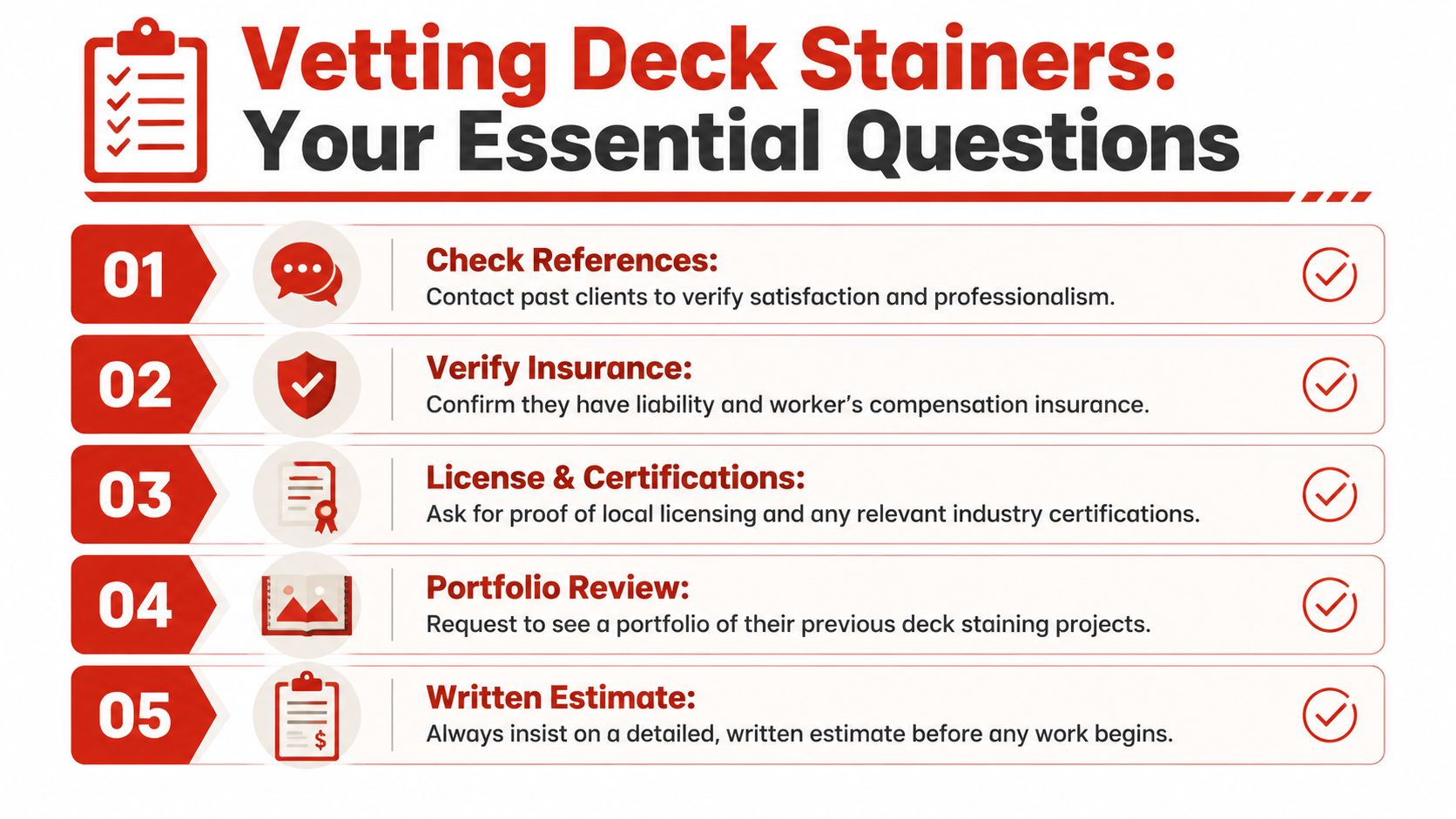
Once you've got a shortlist, the next step is simple. Verify that the business is real, insured, and able to explain its process without hiding behind vague language.
A deck staining quote isn't just a labour booking. The contractor will be working on an exposed timber surface where coating failure usually traces back to decisions made before the first coat goes on. That makes credentials and process more important than polished sales talk.
What to verify before you compare personalities
Start with the business basics. A professional operator should be easy to identify and willing to answer direct questions.
Check these first:
- ABN details so you know you're dealing with a registered business.
- Insurance position including public liability. For context, Newline Painting carries $20M public liability insurance and explains that coverage on its page about public liability insurance for painters.
- Team capability. Ask whether the work is done by trade-qualified painters or subcontracted more loosely.
- Written quoting process. If they won't document the scope properly, disputes later are more likely.
If you want background on what insurance questions are worth asking trades generally, this guide on how to find general contractor insurance requirements gives a useful framework.
Questions that reveal actual deck knowledge
The fastest way to separate a serious contractor from a risky one is to ask technical questions and listen for specific answers. You're not looking for jargon. You're looking for a method.
Ask questions like these during the call or site visit:
-
How do you assess a deck that has an old coating on it?
The right answer should mention inspection of coating condition, wear patterns, adhesion issues, and whether the existing finish can be maintained or needs removal. -
What's your preparation sequence for previously coated timber?
A competent answer should cover removal of failing finish, cleaning off contaminants and biological growth, sanding to an even profile, and making sure the timber is dry before staining. -
How do you decide between oil-based and water-based stain systems?
They should be able to explain the trade-off. Oil-based products are often chosen for deeper penetration. Water-based systems are often selected for lower VOCs and easier cleanup. -
How do you handle patchy boards, repairs, or areas that absorb differently?
Good contractors know that inconsistent timber condition changes the finish and may require extra prep or a revised recommendation. -
What would make you delay the job once it's booked?
If they don't mention moisture, rain risk, poor drying conditions, or deck temperature, they may be more focused on finishing the booking than protecting the outcome.
A reliable deck stainer should be comfortable saying, “This isn't ready to coat yet.”
Listen for what they don't say
There are also revealing omissions.
Be cautious if the contractor avoids discussing prep in detail, can't name stain brands they use, won't explain how adjacent walls or glazing will be protected, or gives you a verbal figure without a written breakdown. Skilled tradespeople don't need to oversell. They usually describe the sequence clearly because they've repeated it many times.
A practical sign of maturity is when the contractor talks about what may change after inspection. For example, a deck in Albert Park with salt exposure and old film build-up may need a different approach from a shaded backyard deck in Camberwell with mildew and leaf staining. The honest answer is not always the fastest one.
Decoding Quotes and Comparing Finishes
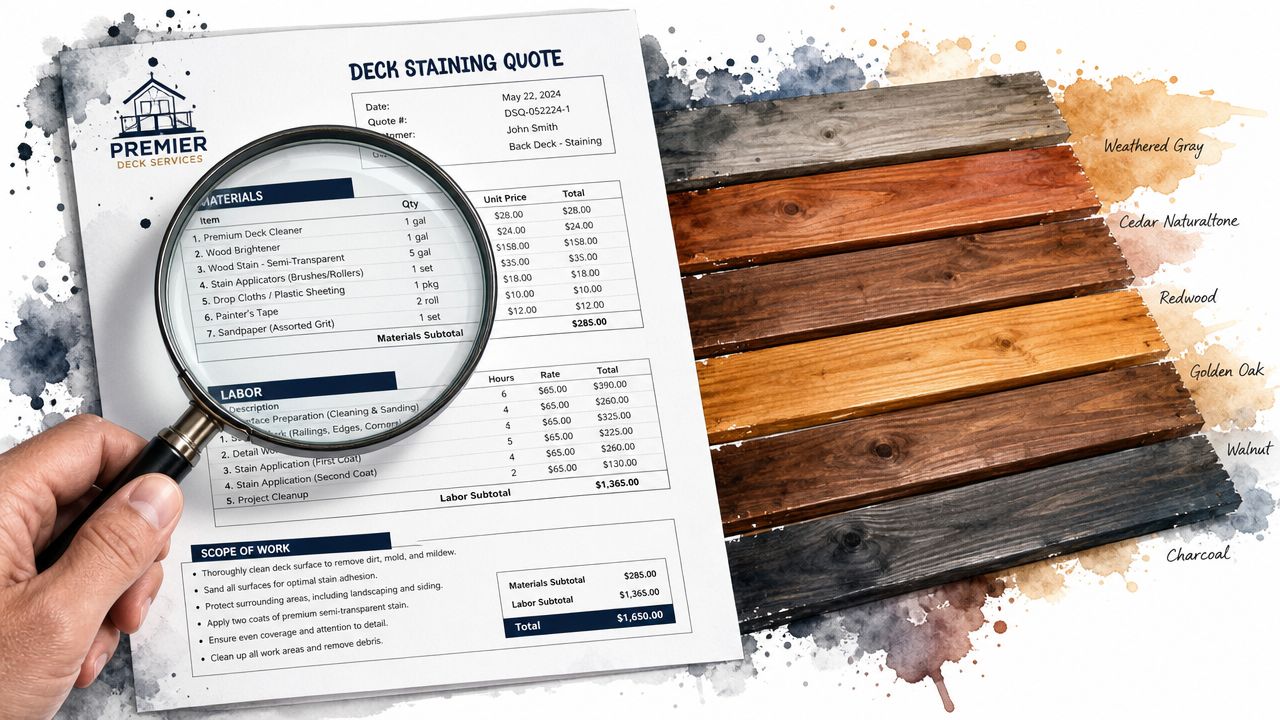
A good deck staining quote should read like a work plan, not a lump sum.
If two contractors give you very different prices, don't start by asking who's expensive. Start by checking whether they've priced the same preparation standard, the same stain system, and the same risk. On deck work, the cheapest quote often excludes the parts that stop early failure.
What a proper quote should spell out
The strongest quotes are specific about scope. They tell you what will happen to the timber before stain is opened.
For deck work near Melbourne, the defensible technical baseline is this sequence: verify moisture content before coating, mechanically remove failing finish, clean off biological growth and contaminants, then sand to an even profile before applying stain. That clean, dry, abraded approach is the professional standard described in guidance from South Bay Wood Restoration.
If a quote skips that sequence and just says “prep and stain deck”, it's too vague.
Look for detail such as:
| Quote item | What you want to see |
|---|---|
| Surface preparation | Mechanical sanding, removal of failing coating, cleaning method |
| Moisture check | Clear note that timber must be dry before coating |
| Coating system | Product type and whether it's oil-based or water-based |
| Number of coats | Stated clearly, not implied |
| Protection | Adjacent walls, paving, glazing, balustrades, furniture |
| Timber defects | Whether minor repairs or replacements are excluded or allowed for |
| Weather clause | Clear note that timing depends on suitable dry conditions |
Compare finish systems by use, not by label
Homeowners often ask which stain is “best”. That's usually the wrong question. The better question is which system suits the deck's exposure, timber condition, and maintenance expectations.
Here's the practical trade-off:
- Oil-based stain often suits decks where penetration matters most and the timber is thirsty or weathered.
- Water-based stain can suit clients who want easier cleanup and a lower-VOC option.
- Heavy film-building promises should be treated cautiously on horizontal timber because movement and wear usually punish rigid surface build-up faster than many homeowners expect.
This is similar to how painters compare interior and exterior coating finishes more broadly. If you want a simple primer on how finish choices affect appearance and maintenance, this guide to paint finishes and sheen levels is useful background.
The coating matters, but the surface condition matters more. Premium product over damp or badly prepared timber still fails.
Price the next maintenance cycle, not just this one
The overlooked part of a quote is future maintainability.
A deck that's cleaned properly, evenly sanded, and coated with the right system is usually easier to maintain next time. A deck that's rushed, over-applied, or coated over unstable residue often becomes more expensive at the next visit because the contractor has to undo the previous shortcut first.
Ask each contractor these lifecycle questions:
- What will this finish require at the next maintenance visit?
- If parts wear faster than others, can the deck be maintained in sections without a full strip?
- What conditions on this site are likely to shorten the maintenance window?
- Would you stain this deck, seal it differently, or recommend another approach based on its current condition?
These questions shift the discussion from a one-off spend to asset management.
A practical comparison example
Say you receive two quotes for a rear entertaining deck in Hawthorn. One quote says “wash, light sand, two coats”. The other notes moisture check, removal of loose coating, treatment of weathered traffic lanes, full sand to even out absorption, and a specific stain system selected for exposure.
The second quote may cost more. It may also be the only one that addresses why the old finish failed in the first place.
That's the difference between buying colour and buying durability.
Preparing for the Project and What to Expect
Once you've chosen a contractor, the project should run to a clear sequence with good communication around weather, access, protection, and handover.
This part matters more in Melbourne than many homeowners realise. Australia has some of the highest ultraviolet levels in the world, and Melbourne's seasonal rainfall and humidity shifts affect coating cure times and maintenance timing. That combination is why professional deck staining is usually framed as protection work, not just appearance work, as outlined in this summary of UV exposure and weather effects on deck coatings.

What you should do before the crew arrives
Homeowners can make the job smoother by clearing the deck properly. Remove furniture, pot plants, mats, planters, barbecues, and any small items stored against walls or balustrades. If there are access issues through the house or side path, confirm them early.
It also helps to flag anything sensitive near the work zone. That might include freshly painted walls, exterior furniture cushions, pet access, or glass doors that need extra protection during prep.
What a professional contractor should manage
The contractor should control the work area and communicate the sequence clearly. That includes protecting adjacent surfaces, containing dust and residue as reasonably as possible, and keeping the site organised at the end of each day.
A sound process usually includes:
- Site protection for walls, windows, nearby paving and landscaping where needed.
- Preparation first rather than trying to “get some stain on” quickly.
- Weather monitoring so the deck isn't coated into unstable conditions.
- Clear access advice about when you can walk on the deck and when furniture can return.
Melbourne weather can change the schedule quickly. Good contractors don't disappear when that happens. They update you and reset expectations before the coating is compromised.
Expect a final check, not just a finished invoice
The best handovers involve a walkthrough. You should be shown the completed finish, any areas where timber condition still affects appearance, and the aftercare guidance for the first period after completion.
This is also where process-heavy companies stand out. Newline Painting, for example, works from a written quote, uses recognised paint brands such as Dulux, Haymes, Taubmans, Berger and Wattyl, and backs workmanship with a 7-year warranty. Whether you hire them or another contractor, that level of documented process and accountability is what you want to see at the end of the job.
Ask for plain advice on maintenance signs to watch for, especially on heavy-traffic zones, steps, and edges. A good contractor won't promise the deck will age uniformly in every spot. They'll tell you where wear is most likely to appear first and what to do when it does.
Common Red Flags and Ensuring a Quality Outcome
The clearest red flags are vague scope, weak accountability, and any attempt to make preparation sound optional.
A risky operator usually wants the decision made quickly and the details discussed later. That's backwards. On deck work, the details are the job.
Warning signs that should make you pause
Watch for these problems during quoting and follow-up:
- A one-line quote with no preparation detail, no coating system, and no note about weather conditions.
- Downplaying sanding or moisture checks as unnecessary.
- Cash-only pressure or anything that makes the paper trail disappear.
- Large upfront pressure before scope and scheduling are clearly documented.
- No clear answer on insurance or business details.
- Overconfident promises on finish life without seeing how the deck has weathered.
A professional can be direct without being slippery. If they know what they're doing, they'll explain what they can control and what depends on timber condition, exposure, and maintenance.
What quality usually looks like in practice
A quality outcome comes from method, not theatre. The contractor inspects the deck properly, writes the scope clearly, prepares the timber thoroughly, chooses a stain system for the conditions, and communicates if weather interrupts the plan.
That's also why local knowledge matters. A deck in a shaded Richmond courtyard behaves differently from one exposed to bayside air in Brighton. The right contractor adjusts the process to suit the site rather than forcing the same template onto every job.
If a contractor talks more about “getting it done fast” than about timber condition and preparation, keep looking.
The safest hire is usually the one that gives you a clear written scope, stands behind the work, and doesn't need to hide the process.
If you want a detailed, obligation-free assessment of your deck, Newline Painting can arrange a free on-site quote across Melbourne. If you'd rather talk it through first, call 1300 044 206 and ask about preparation standards, coating options, and what would suit your deck's current condition.